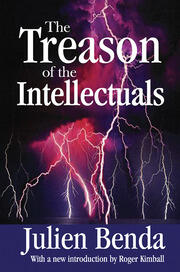
When the French philosopher and thinker Julien Benda (1867–1956) published his book The Treason of the Intellectuals (La Trahison des Clercs) in 1927, he was not merely composing a passing obituary for a generation of writers. Rather, he was sounding an alarm whose echoes continue to reverberate to this day.
Europe at that time was living through the interwar period, groping its way amid the ruins of collapsing values and the rise of strident ideologies. In this charged atmosphere, Benda observed something peculiar: those intellectuals who were supposed to be guardians of truth had transformed themselves into servants of ideological agendas, theorists of factionalism and partisanship, and architects of hate-filled discourse. From this astute observation emerged the idea of treason—not treason against a nation or a community, but treason against the very mission of thought itself.
It was a higher and more dangerous form of treason: the intellectual’s betrayal of his historical function as an independent conscience standing above conflicts, above groups, above parties, and above ideologies—not immersed within them all.
In the classical conception defended by Benda, the intellectual was a being devoted to abstract universal values embodied in truth, justice, and reason. He was not required to withdraw from the world, but rather to preserve a critical distance that enabled him to tell his party and his group, “No,” when they strayed, and to tell his circle, “You are wrong,” when they lost their way. This distance is the essence of intellectual independence, and it is precisely what intellectuals abandoned when they became entangled in the battles of identity and ideology.
For Benda, treason begins the moment an intellectual replaces the question, “What is the truth?” with the question, “What serves my group?” At that moment, reason ceases to be an instrument of inquiry and becomes an instrument of justification. This subtle shift, which may appear innocent at first, is, in Benda’s view, the root of the catastrophe.
The Humiliation of Belonging
What made Benda’s thesis profound was that he did not explain this treason through coercion but through temptation. Intellectuals are rarely driven into the service of their group by force; rather, they rush toward it willingly, propelled by ambition, a desire for influence, or the exhilaration of belonging to a grand project.
There is a hidden pleasure in feeling oneself part of a sweeping current and sensing one’s voice amplified when merged with the chorus. Independence is lonely and costly; it requires the intellectual to endure isolation and to accept being rejected by his own camp whenever truth demands it. Engagement, by contrast, offers warmth, recognition, and the comforting feeling of being “on the right side of history.” Thus, the souls of intellectuals are purchased not through threats, but through honors.
Once the intellectual accepts this bargain, his intellectual dependency gradually takes root until he loses the ability to see the group from the outside. He becomes part of the machinery that produces official discourse, granting cultural legitimacy to despotism, dressing violence in the garments of necessity, and transforming injustice into a “historical inevitability.” The one who was meant to be a guardian becomes the jailer without even realizing it.
The Collapse of Values
The great disaster against which Benda warns is not merely political; at its core, it is epistemological and moral. When an intellectual aligns himself with a particular ideology, he does not simply change his position—he redefines truth itself in favor of his group.
The values of justice, integrity, and honesty cease to be independent universal principles and become functional instruments. Justice is no longer justice in the absolute sense, but rather whatever serves “our cause.” Truth is no longer objective truth, but whatever reinforces “our narrative.” At this point, knowledge slides into a dangerous relativism in which everything becomes conditioned by loyalty, and the truthfulness of a statement is measured not by its correspondence to reality but by its affiliation with the correct camp.
This shift empties thought of its meaning. A mind that automatically justifies everything its group does is no longer a mind at all; it is merely a machine for defending the group, the party, and the clique. Likewise, an intellectual who knows the conclusion of his research before activating the tools of scientific inquiry and gathering evidence is no longer a researcher but an advocate. When thought loses its independence, it loses all its value, because the value of thought lies not in what it says but in its freedom to say what its own group would rather not hear.
The truth is that Benda’s thesis, despite being nearly a century old, has never been more relevant than it is today. What occurred yesterday at the Journalists’ Syndicate—the honoring of the fugitive Muslim Brotherhood member Salah Abdel Maqsoud, not to mention the hijacking of the General Assembly by a particular clique known to all and sundry, acting as though it owned a hereditary estate rather than a professional union of opinion—confirms that we live in an age in which many bearers of the pen have become instruments of polarization. They line up in opposing camps and measure their positions by the scale of loyalty rather than the scale of truth.
In the age of social networks, the temptation Benda warned against has become even more lethal. Applause is instantaneous, belonging is publicly declared, and isolation is harsher than ever. Those who tell their audience what it wants to hear are rewarded, while those who dare to disagree are punished. Thus proliferate intellectual tribes that demand loyalty rather than criticism, mobilization rather than questioning.
Perhaps the most enduring lesson from Benda is this: intellectual independence is not a luxury but a condition of existence. A mind that loses the freedom to question its own group before questioning its opponents ceases to be a mind and becomes merely an echo.
The treason of intellectuals remains more an open question than a closed judgment. Benda does not offer a ready-made formula for salvation, nor does he claim that complete neutrality is possible. What he offers is a mirror, asking every thinker to look into it honestly and ask himself: Am I seeking the truth, or am I merely justifying what I belong to? Do I preserve my right to disagree with my group, or have I sold that right in exchange for the warmth of belonging?
The value of the intellectual is not measured by his ability to defend his cause—that is what lawyers, politicians, and preachers do. Rather, the value of the intellectual is measured by his ability to criticize his group, his party, and his clique when they are wrong, and to leave them when they become unjust. That is the trust whose betrayal Benda warned against. That is the distance which, if reason loses it, it loses its soul.
And so the challenge remains in every generation: to belong without becoming captive, to engage without becoming blind, and to participate in the struggles of one’s age without losing the compass that transcends them.