When the Judge Is Punished Instead of the Perpetrator: The Removal of Karim Khan, the Prosecutor Who Sought Netanyahu's Arrest
On a cold winter day in Paris, a
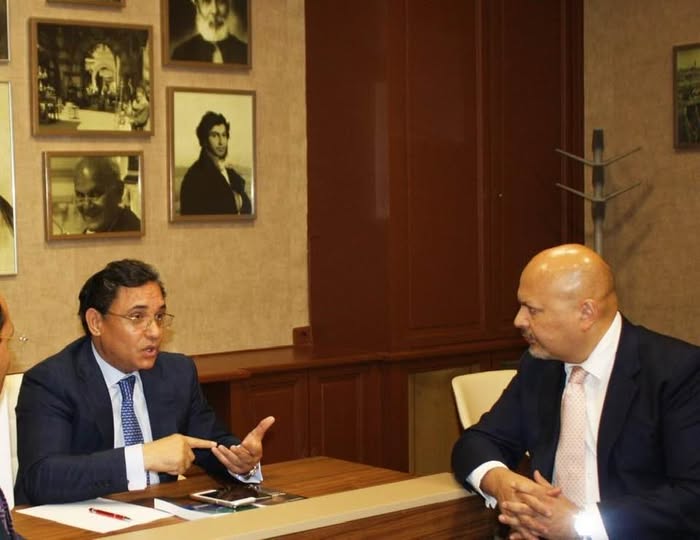
soft-spoken, meticulously articulate man sat in my office. He belonged to that
rare breed of lawyers who never raise their voices because they have no need
to. At the time, Karim Ahmad Khan was at the height of an exceptional legal
career: a British lawyer of Pakistani origin who had served before the
tribunals for the former Yugoslavia, Rwanda, and Sierra Leone. He had appeared
both as a prosecutor and as defense counsel—a dual role that very few have
managed to combine with integrity. That same year, he was appointed to lead the
United Nations Investigative Team tasked with examining the crimes committed by
ISIS in Iraq.
What has remained with me from
that meeting is neither his office nor his title, but a conviction he expressed
without any display or affectation: international justice must either apply
equally to everyone, or it is not justice at all.
Three years later, the States
Parties elected him Prosecutor of the International Criminal Court. I called to
congratulate him on his new position, and he was, as always, gracious and
courteous.
Then, just two days ago, on July
24, 2026, those same States voted to remove him from office.
What Exactly Happened?
In November 2024, a Pre-Trial
Chamber of the International Criminal Court issued arrest warrants for Israeli
Prime Minister Benjamin Netanyahu and his former Defense Minister Yoav Gallant
on charges of war crimes and crimes against humanity committed in Gaza,
alongside a warrant for a Hamas leader.
The request for those warrants
had been submitted by Khan in May of the same year. It marked the first time in
the Court's history that it had issued an arrest warrant for the head of
government of a state that is a major ally of the United States and the West.
The price was swift.
The United States imposed
sanctions on the Prosecutor himself, followed by sanctions targeting judges and
officials of the Court. A public diplomatic campaign was launched to undermine
the institution, reaching its peak this month when U.S. Secretary of State
Marco Rubio described the Court's personnel in terms unworthy of diplomatic
language.
Meanwhile, a parallel network was
taking shape to ensnare the fiercest prosecutor in the Court's history.
A staff member of the Court filed
a complaint alleging sexual misconduct. From the very first day, Khan's Office
categorically denied the allegations and continues to do so.
The problem is not that an
investigation was conducted.
The problem lies in ignoring its
outcome.
That is the heart of the matter,
and it is on this point alone that any condemnation should rest—not on
questioning a woman who came forward with a complaint, for that is her
protected right, but on the manner in which the States Parties handled the case.
First
The United Nations Office of
Internal Oversight Services (OIOS) investigated the matter for thirteen months
and submitted a report accompanied by thousands of pages of evidence.
Second
The Bureau of the Assembly of
States Parties itself established an independent judicial panel composed of
three distinguished judges:
Leona Theron of the
Constitutional Court of South Africa;
Paul Lemmens of Belgium; and
Seymour Panton of Jamaica,
to evaluate that evidence.
The judges spent approximately
three months examining the material and issued their report on March 9, 2026.
They unanimously concluded that
the facts established by the investigation did not substantiate misconduct or a
breach of duty under the applicable legal framework.
One of the judges even appended a
separate opinion expressing serious doubts regarding the allegations.
Third
Here lies the true heart of the
story.
The Bureau did not accept that
conclusion.
Within weeks, a majority of its
members voted to disregard the findings of the very panel that the Bureau
itself had appointed. On June 8, they referred the matter to the Assembly of
States Parties for a vote, while immediately suspending the Prosecutor from his
duties.
On July 24, 82 out of the 125
States Parties voted in favor of removing Karim Khan from office.
According to the defense team,
Khan was never formally confronted with the specific allegation upon which the
removal decision was ultimately based, nor was he afforded an opportunity to
respond to it.
The defense further states that a
formal request for an oral hearing—during which testimony could be examined and
credibility assessed—had been submitted as early as July 2025, yet it was never
granted.
A Fabricated Process
Ben Swanson, the former Deputy
Director of the United Nations Office of Internal Oversight Services, described
what occurred as a major procedural fabrication.
More troubling still, a political
executive body substituted its own judgment for that of independent judges in
assessing disputed evidence.
This is precisely what Sir James
Eadie warned against in a legal opinion issued in late 2025, when he argued
that it is fundamentally unacceptable for an investigator to assume the roles
of both prosecutor and judge, and that factual determinations must not be left
to political bodies.
Why Does This Decision Extend
Beyond Karim Khan?
No one outside the case file can
claim with certainty to know what transpired between two individuals behind
closed doors.
What every fair-minded defender
of the rule of law can state with certainty is this:
The institution established to
prosecute the gravest crimes under the highest standards of fairness applied to
its own Prosecutor a lower standard than the one it applies to any defendant
appearing before it.
This is not a defense of a man.
It is a defense of a principle.
For the principle that falls
today in The Hague is the very one that tomorrow will be invoked against
victims:
If a political body may disregard
the judgment of independent judges whenever it finds that judgment
inconvenient, then the very idea of international justice has been reduced to
an instrument of power politics.
The cruelest irony remains this:
The man was removed from office,
while the arrest warrants he sought remain in force—and none of them has been
executed.
Regrettably, the prosecutor has
fallen, while the accused remain at liberty.
I do not write from the position
of someone seeking to exonerate or condemn in a matter that has never been
fully adjudicated before a competent court.
I write from the position of
someone who refuses to accept that the process leading to this removal should
become the model by which international justice judges itself.
The man who sat in my office in
Paris in 2018 believed that law is stronger than politics.
Perhaps what has happened to him
is the greatest test of that conviction.
Despite everything, I hope he was not mistaken.