Trump Speech Patterns Shift as New Analysis Examines His Rhetoric at 80
Monday 02/November/2026 - 03:16 PM
Ahmed Seif El-din
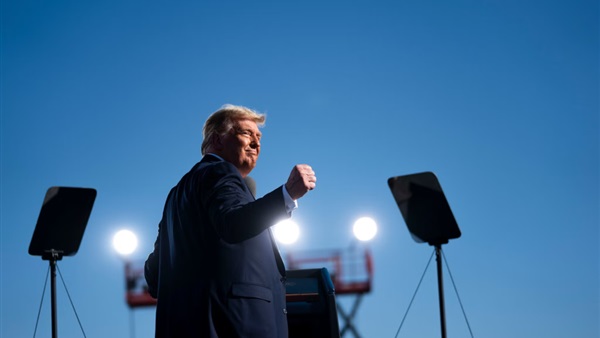
Trump speech patterns have become more profane, repetitive, lengthy and difficult to follow than they were during his first presidential campaign, according to an AI-assisted review by The New York Times. The findings have renewed debate about President Donald Trump's public communication, political messaging and age as the 2026 midterm elections approach.
The analysis, published November 1, examined Trump's speeches, campaign rallies, interviews, social media posts and public appearances from 2015 through late October 2026.
It found substantial differences between his communication today and a decade earlier, although the changes since a similar review in 2024 were generally smaller.
Trump, who turned 80 in June, continues to maintain an active campaign presence. His supporters praise his spontaneity and energy, while critics argue that his increasingly provocative remarks raise questions about judgment and presidential conduct.
The findings describe observable changes in his public language, but they do not establish a medical diagnosis or prove cognitive impairment.
Trump Speech Patterns Show Changes Over a Decade
The review identified several measurable shifts in Trump's speaking style since his first presidential campaign.
The study also found that Trump's vocabulary and estimated speaking-grade level have remained relatively stable, generally between fourth and fifth grade. The researchers cited an eighth-grade average for modern presidents.
The analysis used AI-assisted methods to evaluate speech characteristics. Its conclusions should therefore be understood as linguistic findings, not clinical assessments.
Repetition Raises Questions About Speech Organization
At a recent rally in Greenville, North Carolina, Trump recounted the Willie Horton criminal case that influenced the 1988 presidential campaign of Democratic nominee Michael Dukakis.
Approximately 30 minutes later, he repeated the same account, using some of the same language.
According to the Times, both versions contained factual inaccuracies.
The incident illustrates a broader pattern identified in the review: Trump frequently returns to previous subjects, repeats stories and moves between topics without clearly completing his original point.
He describes this approach as "the weave," presenting it as an intentional speaking technique that allows him to connect apparently unrelated subjects.
His critics, however, question whether increasingly extended digressions undermine the clarity of his message.
Longer Rallies and More Absolutist Language
Trump's average campaign rally has nearly doubled in duration, increasing from 42 minutes in 2016 to approximately 85 minutes in 2026.
His speeches also contain more categorical expressions, including words such as "always," "never," "everything" and "totally."
The review found a 19% increase in this language compared with a decade earlier and a 5% increase compared with 2024.
Researchers noted that black-and-white language can accompany age-related changes, although such patterns are not sufficient to establish cognitive decline.
Profanity has also become more frequent.
Trump now uses nearly 15 swear words per 10,000 words, compared with 14 in 2024 and six during his original presidential campaign.
Former Republican Representative Francis Rooney criticized the president's increasingly aggressive rhetoric, saying he had not previously encountered that style of presidential communication.
The White House rejected suggestions that Trump had lost effectiveness.
Spokesman Davis Ingle defended the president's mental sharpness, energy and work ethic, arguing that voters appreciate his direct and unconventional communication.
Cognitive Tests Become a Recurring Campaign Theme
Trump has repeatedly discussed his cognitive abilities during recent campaign appearances.
In May, White House physician Dr. Sean P. Barbabella released a three-page medical summary reporting that Trump scored 30 out of 30 on the Montreal Cognitive Assessment.
The physician described his cognitive and physical performance as excellent.
The Montreal Cognitive Assessment is a brief screening tool used to identify possible cognitive impairment. It includes tasks involving memory, attention, language, animal identification and clock drawing.
A perfect score is a favorable screening result, but the assessment does not comprehensively evaluate every aspect of cognition or establish that someone has exceptional intelligence.
Nevertheless, Trump has repeatedly presented his performance as evidence of unusual intellectual ability.
At an October rally in Bullhead City, Arizona, he described himself as a genius after discussing the test.
During another appearance in Chillicothe, Ohio, he said he had passed three cognitive assessments and compared his abilities favorably with former Presidents Barack Obama and Joe Biden.
Those comparisons reflected Trump's own claims rather than independently established medical findings about his predecessors.
Social Media Activity Remains High Despite a Reduced Public Schedule
The review found that Trump's public schedule has become less crowded compared with his first administration.
He now averages approximately 1.3 public events per weekday, compared with 2.1 during his first term.
However, his online activity remains substantial.
Trump posts an average of 21 times daily, compared with 13 posts per day in 2016 and 34 in 2024.
During his second term, he has posted between midnight and 5 a.m. on approximately 30% of nights.
Researchers also identified 240 instances in which he published at least 10 posts within a single hour.
These figures demonstrate continued online engagement, but posting frequency alone cannot establish a person's physical health, mental condition or work capacity.
Trump's Unscripted Remarks Create Political Controversies
Beyond measurable changes in Trump speech patterns, the analysis documented increasingly provocative comments on immigration, elections, energy and national security.
At a construction site, Trump made a remark suggesting that a Hispanic worker would be uniquely capable of surviving a dangerous fall.
He also referred to the strategically important Strait of Hormuz as the "Hormone Strait."
In remarks about the November 3 elections, he urged supporters to "cheat like hell," while elsewhere suggesting that military personnel responsible for leaking sensitive information should be shot.
The remarks drew attention because of their potential implications when spoken by a sitting president.
Some Trump allies argue that critics interpret jokes and rhetorical exaggerations too literally.
That distinction matters: provocative language does not necessarily represent a formal government policy or operational instruction.
Nevertheless, the president's words carry institutional weight, particularly when addressing elections, military discipline or national security.
Energy Comments Illustrate Political Risks
During a rally in Perry, Georgia, Trump praised the financial benefits of high oil prices for the fossil fuel industry.
He acknowledged that his comments could produce unfavorable headlines because many Americans remain concerned about gasoline costs.
He nevertheless defended the economic gains enjoyed by energy companies.
The remarks illustrated the tension between Trump's spontaneous style and the political need to address voters' everyday financial concerns.
Extended Digressions Complicate Political Messaging
One example highlighted by the Times occurred during a rally in Pendleton, South Carolina.
Trump began discussing transgender athletes in women's sports before shifting to George Washington, Abraham Lincoln, an encounter with a young Israeli man, an unexplained presidential poll and climate policy.
The transitions were abrupt, and several thoughts were left unfinished.
Trump has long used anecdotes, personal commentary and unexpected subject changes to entertain supporters.
His defenders view these techniques as part of his distinctive political appeal.
Critics argue that the increasing frequency and length of such digressions can make it difficult to identify the central argument of a speech.
The review found that confusing digressions were approximately two and a half times as frequent as during the 2016 campaign, although their prevalence was broadly similar to 2024.
This distinction is important: the strongest measured change occurred over the decade, not necessarily during the past two years.
Personal Remarks About Politicians Draw Attention
The Times analysis also examined Trump's growing willingness to comment publicly on the physical appearance of political figures.
In October, Trump repeatedly praised the physique of Republican Senator Jon Husted of Ohio, including making explicit remarks about his backside.
He returned to the subject at rallies in Ohio, Kentucky and North Carolina.
Trump also complimented several other male political figures, including Senator Tim Scott, Health and Human Services Secretary Robert F. Kennedy Jr. and Representative Mike Collins.
He praised the appearance of the spouse of Senator Darline Graham, as identified in the supplied report.
At a Michigan appearance, he also made a remark about entertainer Nicki Minaj's physical appearance.
These comments became notable because of their frequency and unusually personal nature in presidential speeches.
However, the remarks themselves do not establish a medical explanation for his behavior.
Confrontations With Reporters Become More Personal
Trump's relationship with the news media has been confrontational throughout his political career.
Recent exchanges suggest that his responses have become increasingly personal and insulting.
During an Oval Office encounter on October 20, he angrily challenged a reporter asking about the East Potomac golf course project.
At another appearance, he criticized a journalist's physical appearance after being asked whether he was canceling a Kansas trip because of fatigue.
He has also frequently interrupted reporters, questioned their motives and used derogatory descriptions.
His rhetoric toward political opponents has similarly intensified.
The review cited disparaging nicknames directed at Democratic politicians James Talarico and Annie Andrews, alongside Trump's claim that he does not habitually mock people.
These contradictions have become a recurring feature of criticism surrounding his public statements.
Immigration, Iran and the Nobel Peace Prize
Trump's remarks about international affairs have also attracted scrutiny.
He has repeatedly expressed frustration over not receiving the Nobel Peace Prize, despite portraying himself as an influential peacemaker.
During one appearance in Pendleton, he appeared to confuse the Nobel Prize with the Pulitzer Prize.
At a later rally in Port Huron, Michigan, he suggested excluding immigrants from Norway because of his disappointment over the award.
The comment was particularly striking because the Nobel Peace Prize is awarded by a Norwegian committee, although Trump's statement did not constitute a confirmed immigration policy.
The president also recently threatened to "annihilate" Iran, illustrating the contrast between his peace-related rhetoric and his willingness to use aggressive language in foreign affairs.
In other remarks, Trump asserted broad presidential authority, declaring that he could do whatever he wanted.
He also advocated replacing the term "artificial intelligence" with "super intelligence" and criticized technology companies that continued using the existing terminology.
These statements reflect his increasingly confrontational public communication, but their practical policy consequences depend on whether formal government actions follow.
Is Trump's Speaking Style Changing With Age?
The central question raised by the analysis is whether the changes in Trump speech patterns reflect aging, deliberate political performance or a combination of factors.
Trump became the oldest person inaugurated as U.S. president in 2025 and turned 80 in June 2026.
His age makes questions about presidential fitness politically relevant, particularly as he continues a demanding schedule of campaign appearances and official responsibilities.
Yet assessing cognitive health through public speeches has significant limitations.
Speech length, profanity, repetition and abrupt topic changes may provide useful observations, but they cannot independently establish a neurological condition.
A clinical evaluation would require more comprehensive medical information than is available from rallies, interviews and social media activity.
The White House maintains that Trump remains mentally sharp and physically capable.
His supporters also argue that his informal communication is a longstanding political strength rather than evidence of deterioration.
The Times review, meanwhile, documented substantial linguistic changes since 2015, with fewer differences between 2024 and 2026.
The Political Significance of Trump's Changing Rhetoric
As Republicans campaign ahead of the November 3 midterm elections, Trump's communication style remains central to his political identity.
His lengthy speeches, confrontational language and unpredictable remarks generate attention and enthusiasm among supporters.
They also create opportunities for opponents to question his judgment, discipline and effectiveness.
At a recent rally in Clarksville, Tennessee, Trump acknowledged that his audience often applauds even his most unusual comments, before insisting that his statements reflect common sense.
At the Republican midterm convention in Dallas in September, he again defended "the weave," saying he ultimately returns to his original subject.
He also suggested that failing to return to that subject in the future might provide critics with a legitimate reason to question his abilities.
The observation captures the central tension in the debate: Trump views his unconventional speaking style as a defining political asset, while critics increasingly regard it as a cause for concern.
The available evidence supports a narrower conclusion than either side's most sweeping claims.
Trump speech patterns have measurably changed over the past decade, particularly in duration, profanity, absolutist language and the frequency of confusing digressions. But those changes, without additional clinical evidence, cannot establish their underlying cause.
What remains clear is that Trump's public rhetoric continues to shape political debate, drawing intense attention to both his governing priorities and the manner in which he communicates them.