Canada-EU Associate Membership: Carney Sets 2027 Goal Amid U.S. Trade Dispute
Saturday 31/October/2026 - 01:07 PM
Ahmed Seif El-din
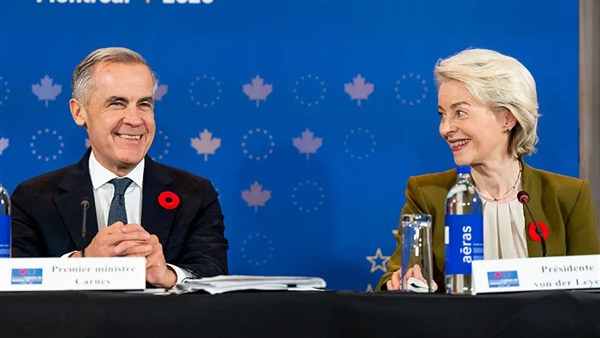
Canadian Prime Minister Mark Carney is advancing plans for Canada-EU associate membership as Ottawa seeks to strengthen its economic and strategic ties with Europe amid escalating trade tensions with the United States. The proposed arrangement, discussed during the October 29–30, 2026, EU-Canada summit in Montreal, could establish a new framework for cooperation without granting Canada full European Union membership.
Canada and EU Launch Strategic Alliance
Carney and European Commission President Ursula von der Leyen announced the Alliance for the Future, a partnership designed to strengthen economic resilience, technological cooperation, and strategic independence.
The initiative will prioritize artificial intelligence, energy security, critical minerals, quantum technology, and other sectors considered essential to economic competitiveness.
Carney described Canada-EU associate membership as an opportunity to establish the closest possible relationship with the European Union short of full accession.
The Canadian leader aims to conclude negotiations during a meeting of European leaders in June 2027. However, the summit's final declaration stopped short of formally endorsing associate membership, instead committing both sides to define a closer association by the 2027 Canada-EU summit.
European Officials Express Reservations
Despite support from Carney and von der Leyen, the proposed Canada-EU associate membership faces questions among European officials.
German Ambassador to Canada Matthias Luttenberg acknowledged that some EU member states were surprised by the proposal and would need time to assess its implications.
European Commission spokesperson Paula Pinho confirmed that negotiations would continue with the European Parliament, member states, and Canadian representatives.
She acknowledged that EU governments had not reached complete agreement on the initial wording but emphasized that the summit established a foundation for further discussions.
The distinction is significant: Canada-EU associate membership remains a political proposal rather than an approved legal status, and its rights, obligations, and institutional structure have yet to be determined.
U.S.-Canada Trade Dispute Accelerates Diversification
Canada's efforts to deepen European relations follow the collapse of trade negotiations with Washington in August.
Ottawa subsequently introduced retaliatory tariffs, while the White House removed duties on selected Canadian products. U.S. President Donald Trump has also threatened additional economic measures and repeated remarks about making Canada the 51st U.S. state.
Trump criticized the proposed European arrangement and threatened substantial tariffs or trade restrictions against Europe if it proceeded.
For Carney, strengthening Canada-EU trade relations forms part of a broader strategy to reduce dependence on the American market.
According to Canada's annual trade report, 72.5% of Canadian merchandise exports went to the United States in 2025, highlighting the challenge of diversifying trade relationships.
Dalhousie University political science professor Lori Turnbull noted that alternative trading partners could strengthen confidence in Carney's approach, although no market could fully replace the United States.
Economic and Educational Opportunities
Beyond trade and security, the proposed EU-Canada partnership could create opportunities for young Canadians to study, travel, and live in Europe.
Von der Leyen emphasized that geographical limitations prevent Canada from becoming a conventional EU member but said both sides want to develop the closest relationship possible.
The broader alliance could also support investment, supply-chain resilience, technological innovation, and cooperation on strategic resources.
However, specific mobility rights, market-access arrangements, and regulatory commitments remain undefined.
U.S.-Canada Trade Negotiations Continue
While pursuing closer European ties, Ottawa continues discussions with Washington over tariffs affecting major Canadian industries.
Carney said negotiations had shown some progress but stressed that Canada would accept an agreement only when it served Canadian interests.
Trump has suggested that the dispute could be resolved soon, although neither government has announced a final agreement.
According to Reuters, citing American and Canadian sources, negotiators are exploring measures to ease U.S. tariffs on Canadian steel and automobiles.
The automotive industry remains particularly vulnerable. Royal Bank of Canada estimated bilateral automotive trade at approximately $100 billion, while Trump has threatened tariffs of up to 50% on Canadian vehicles and automotive parts beginning January 1, 2027.
Honda executive Jennifer Thomas warned that such an increase could have catastrophic consequences for the industry.
Turnbull argued that securing relief for major industries would be essential for Carney to obtain provincial support for any future trade agreement.
What Comes Next for Canada-EU Associate Membership?
The coming months will determine whether Canada-EU associate membership develops into a formal arrangement acceptable to all 27 EU member states.
Carney's government must simultaneously manage negotiations with Washington, protect key Canadian industries, and demonstrate the economic value of closer European integration.
Although the proposed partnership offers a potential path toward greater trade diversification and strategic autonomy, its practical benefits will depend on the agreements ultimately reached.
For now, Canada-EU associate membership represents an ambitious diplomatic initiative, not a finalized membership agreement, as Ottawa seeks to reshape its international partnerships amid continuing uncertainty in U.S.-Canada relations.