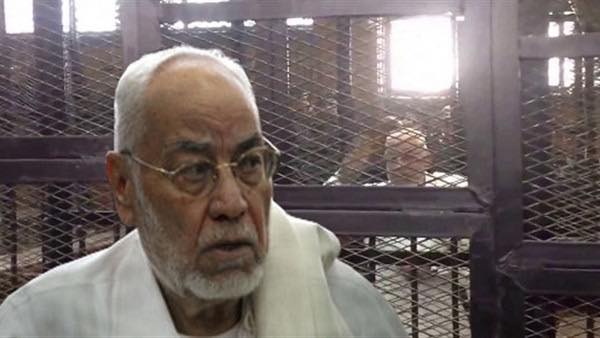
At five in the afternoon, Cairo time (35).. America and the Muslim Brotherhood (7)
The Testament of Mahdi Akef
We continue reading the report
submitted by Mahdi Akef to the Guidance Bureau in Egypt after his return from
the United States of America.
Here, we present the vision of
the leadership of the organization in America regarding the issue of secrecy
and openness, as stated in Mahdi Akef’s report.
Second: The Leadership’s Vision
Mahdi Akef continues to present
the views of the Brotherhood’s leadership in America on the concept of secrecy
and openness and the usefulness of each for the work. In a paper entitled “A
Picture of the Situation in America as It Actually Is,” he states:
At present, the issue of openness
and secrecy clearly dominates the concerns of the Brotherhood in America. This
matter is no longer limited to responsible brothers or those at the initial
organizational levels “family head and above,” but has become a topic of
discussion across the entire base, and a question raised by everyone connected
to the work, even if their connection is limited. There was no meeting in which
I met the brothers without this issue being raised intensively and insistently,
despite my attempts to downplay the matter, emphasize unity of ranks, and
stress adherence to the ethics of discipline.
The general position of the
majority of the Brotherhood, from the base up to the highest level, is
rejection of the move toward openness, for which they provide several
justifications:
a. The majority present in
America are students, most of whom will return to their countries, and
appearing as a member of the Brotherhood poses a risk to them.
b. Public declaration would not
benefit the da‘wa in any way unless it is under the name of the Muslim
Brotherhood, which is rejected by those calling for openness.
c. Openness would lead to
heightened alertness by local authorities in America, which could result in an
adverse stance toward the organization.
d. The Brotherhood would lose its
control over Islamic organizations that lead Islamic work in America, such as
ISNA, the Arab Muslim Youth Association, the endowment, and others, since these
institutions include all Muslims despite differing orientations. Distinguishing
the Brotherhood through a new organization would stir ideological rivalries
against the group.
e. As long as the new
organization will not carry the name of the Brotherhood—as affirmed by
advocates of openness—there is no need for it, since the Brotherhood’s grip on
public Islamic institutions is strong, and effectiveness can be increased
through these institutions without provocation or embarrassment.
It was natural for Akef, in his
report, to survey the opinions of the branch leadership in America on this
serious issue and include them in his report, which came as follows:
Brother Professor Hani Saqr,
Chairman of the Organizational Shura Council in America.
Brother Professor Mousa Abu
Marzouk, currently a member of the Political Bureau of Hamas and the general
official of the organization in America.
Brother Professor Ahmed al-Qadi
Jibri, responsible for education in the Brotherhood’s branch in America.
Brother Dr. Hussein Ibrahim, a
member of the Shura Council.
Brother Suleiman al-Buheiri, one
of the brothers known for sound judgment and widely consulted.
The orientations of all these
figures differed on certain matters, while agreeing on others, as follows:
Brother Hani Saqr
He believes that openness would
cause multiple problems, most of which align with the cautions mentioned above
regarding public disclosure. He further believes that if openness is
unavoidable, then in order to achieve distinction and root identity and loyalty,
it is necessary to announce the Brotherhood’s name despite the risks involved,
as previously stated.
His position is based on absolute
distrust of the people of the Institute of Thought (by which he means the
International Institute of Islamic Thought), whom he considers the origin of
this new orientation. He believes that Dr. Ahmed al-Qadi is heavily influenced
by them, adopts their views, and defends them. According to him, this creates
severe embarrassment for the Brotherhood as a whole, as their foremost concern
is the presence of Dr. al-Qadi among them as a leader and guide without his
being connected to the Institute of Thought group.
He explains the Brotherhood’s
general aversion to this new orientation by the prominent role played by this
group in the proposed vision for working through it. This was further
confirmed—and the sensitivity of the situation heightened—by the fact that the
person who announced the vision advocating openness and undertook to explain it
was Dr. Jamal Barzinji. Worse still, before announcing this vision, the man had
circulated that it was an established reality with set timelines,
implementation dates, and steps.
Brother Mousa Abu Marzouk
Abu Marzouk rejected the opinion
advocating openness, attributing his rejection to the fact that the group
proposing it largely belongs to the Institute of Thought. He believed that the
view emanating from this group does not represent the opinion of the settled
members of the Brotherhood, and that they were the ones who turned the call for
settlement into the problem of secrecy versus openness, in order to leave the
path open for themselves (a reference to the Institute of Thought group) to
control the organization and direct it according to their vision and
aspirations.
Brother Mousa added that the
problem is embodied in fears of the Institute of Thought group infiltrating the
leadership center. Suspicions about them are many, some even reaching the level
of certainty. There are question marks regarding their relationship with Saudi
Arabia and its intelligence services, and all their orientations fall outside
the scope of the organization. They support every opponent of the Brotherhood,
attend their conferences, and fund them heavily, while contributing nothing to
the organization or its activities.
Moreover, they do not believe
that the leadership of the organization in America has any right to command
obedience or provide direction. They operate with complete independence in what
they propose, presenting their orientations as special global ones unrelated to
the da‘wa.
Hence the Brotherhood’s fears of
them. Brother Mousa criticized Dr. al-Qadi’s escalation of the problem beyond
the framework of America. He requested that, if there is an intention for
responsible brothers to attend to help resolve the issue, this should occur
during the convening of the Shura Council.
Openness for Only a Part of the
Organization
Brother Dr. Ahmed al-Qadi—may God
reward him—came specifically to New Jersey to discuss this matter. Over
approximately four hours, the discussion of the problem proceeded as follows:
First: Dr. al-Qadi presented a
history of Islamic work in America and the role of the Institute of Thought
group in it, especially Dr. Jamal Barzinji, during his student years.
Second: He identified several
points, the most important of which are:
The presentation of the project
(openness) to the brothers was not honest, as it was presented as if the entire
organization would become public, which was never proposed nor intended.
The presentation was based on the
notion that it reflected the orientations and visions of the Institute of
Thought group, and that I (Dr. al-Qadi) was acting on their behalf to present
and defend it while they concealed themselves behind me. This, he says,
diminishes his experience and loyalty, whereas the truth is that this is his
view before it is theirs, and there is no fault in his view coinciding with
that of others.
Dr. al-Qadi stated that he
understands the Institute group deeply, in a way none of the agitated brothers
have yet achieved, and that their experience and expertise are not as
simplistic as the Brotherhood imagines.
Dr. al-Qadi believes that work on
settling the da‘wa can only be effective if carried out by the settled members
themselves, not by arrivals from the East. Therefore, he believes the work
should be exclusive to them, as they are more aware of the environmental
conditions and requirements, and more knowledgeable about life’s affairs and
problems in America.
He also believes that the
existing structures, as an organizational system of the Brotherhood, do not
represent the organization correctly and therefore are unfit to issue sound
decisions concerning the future of the da‘wa in this country. These structures
are controlled by a majority coming from Eastern countries, regardless of
anything else. Accordingly, in his view, the decisions of the organizational
conference, the Shura Council, and others do not express reality nor keep pace
with it. For this reason, he has refused to work as an official or as a member
of the Shura Council as long as the situation remains as it is.
Dr. al-Qadi believes that the
settled members should constitute the core organization, and that others should
participate through the organization’s directives, orientations, and
vision—just as any incoming group to a region in the East would do. No matter
how numerous they are, even if they outnumber the region’s inhabitants, the
region’s directives, vision, and systems remain the binding framework for their
work. This, as he stated and emphasized, is his fundamental principle.
Nevertheless, he agreed to
partially relinquish this principle to work through a local work section, on
the condition that the existing organizational reality be changed so that the
majority would not hold decision-making power through those it elects, often
based on national relationships. Accordingly, he drafted bylaws for this
section containing several provisions, the most important of which are:
a. Membership to be limited to
documented settled members.
b. The section’s language to be
English.
c. The section to enjoy full
freedoms in all areas: decision-making, planning and programming, recruitment
rules, work methods, and others.
d. All of this to be subject
first to the approval of the office, then the Shura Council if necessary.
e. The section’s opinion to be
decisive if the office holds a different view, with the matter referred to the
Shura Council. If the Council sides with the section, its view is implemented;
otherwise, the Shura Council and the office must relinquish their views,
because the section is specialized in its field, and specialization is among
the most beneficial factors in work and should not be constrained, “as he
stated.”
Dr. Ahmed asserts that none of
the brothers currently engaged in the work are fit to lead any public
institution, especially ISNA and the NIT, and that only the settled members can
competently do so. He states that he has many such individuals who can perform
these tasks, and they are fully documented members at the same time.
Dr. Ahmed then mentioned that
despite the effort he exerted in preparing these bylaws, he is certain they
will be rejected by all Brotherhood formations, because they are ethnic
formations before being da‘wa-oriented.
Dr. al-Qadi believes that a
decision from the supreme leadership is necessary in this matter, as the base
no longer respects the opinion of the local leadership here.
When I asked him: How do you
guarantee the base’s commitment to implementing the supreme leadership’s order,
given what you say?
He replied: I believe it will
comply.
At this point, he was opposed by
Dr. Hussein Ibrahim, Brother Suleiman al-Buheiri, and Sheikh Abdul-Muta‘al
al-Jabri.
To be continued tomorrow, God
willing.
Paris: five o’clock
in the evening, Cairo time.