At five in the afternoon, Cairo time (33).. America and the Muslim Brotherhood (5)
President Sadat’s visit to Israel and the signing of the
Camp David Accords led to a deterioration in Egyptian–Arab relations, foremost
among them relations with the Kingdom of Saudi Arabia. This, in turn, naturally
affected his alliance with the Muslim Brotherhood. Sadat therefore summoned the
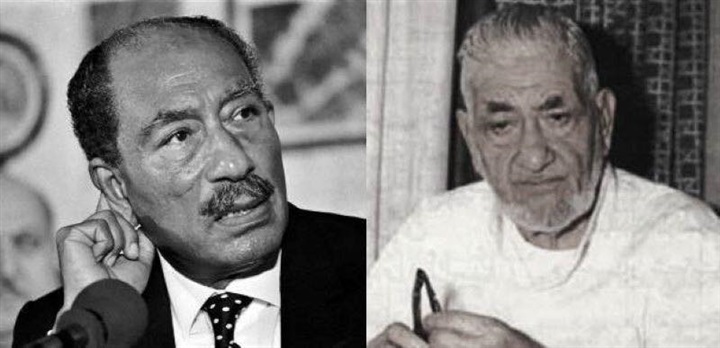
third Supreme Guide, Omar al-Tilmisani, to attend his meeting with writers,
intellectuals, and religious figures.
During the meeting, Sadat spoke about the legitimacy of
the group, stressing that the decision to dissolve it was correct, and that the
publication of Al-Da‘wa magazine—the group’s mouthpiece at the time—was being
carried out illegally. However, he allowed it as a personal favor after they
had been released from prison. Sadat then added, addressing the General Guide
of the group:
What increases the bitterness in my heart is that you,
“Omar,” write to our youth—about whom I speak regarding their formation in a
way that enables them to confront the challenges around us—and yet, on the
front page of Al-Da‘wa, there is an article discussing a letter said to have
come from the American government and American intelligence to Prime Minister
Mamdouh Salem, telling him: Beware… watch out for the boys of the Islamic
groups… because they are very dangerous… strike them and get rid of them. Is
this acceptable? My sorrow is that this approach should have ended after all
that happened in the past, Omar.
Sadat confronted al-Tilmisani, saying:
The youth to whom I say we must face challenges and build
Egypt’s great Islamic structure—how can I now tell them that America has sent a
letter frightening me about you? How can I portray to them an Egyptian
government that has granted all these spaces of movement to the Brotherhood,
only for it to receive such a letter from America and others? Why are you the
ones saying such things? Who are you, Omar? This is unacceptable.
From that date onward, relations between the two men
became tense, and consequently between the group and Sadat.
The Assassination of Sadat
The alliance between the group and Sadat came to an end,
and they immediately announced their rejection of his policies. The Islamic
Group in Upper Egypt met with its counterparts in the Delta, chose Omar Abdel
Rahman as their emir, alongside Aboud al-Zomor and Nageh Ibrahim, and allied
with the Jihad Organization led by Engineer Abdel Salam Farag. All converged
around a single objective: the assassination of Sadat, which they carried out
on October 6, 1981, in what became known as the Parade Stand incident.
Turmoil in the American Branch
Simultaneously with the deterioration of relations
between Sadat and the group, other disturbances occurred within the
Brotherhood’s branch in the United States. These stemmed from the deep linkage
between the American branch and the parent organization in Egypt, which enabled
leaders from outside the American environment to closely interact with the
leadership of the U.S. branch.
Naturally, due to differences in context between the
parent organization and the American branch, deep disagreements emerged when
leaders of the parent organization encountered practices unfamiliar to them in
Egypt.
Most of these concerned methods and priorities, which
they found to be entirely different from those to which they were accustomed in
their homeland. Thus, according to the previously referenced report by Mahdi
Akef, they began to ask:
Where are the strict conditions for membership? Where is
secrecy in organizational work? Where is communication with the organization?
Where are the educational programs? What are the goals of the group here in
America? And what are the objectives of these adopted programs?
This was especially striking given that the ultimate
goal—seizing power and establishing an Islamic state—was entirely absent from
the objectives of the American branch, something that appeared highly unusual
to the parent organization. This would later become a major problem in all the
branches they established in Europe and Canada.
All these questions preoccupied those arriving from the
East. During this period, regional organizational pockets began to form and
differentiate. Rumors and suspicions also began spreading among members
regarding certain individuals in the leadership.
Consequently, major crises erupted within the American
branch during that period, particularly during the general camp held in 1977.
Even after the leadership was changed in 1978, the new leadership faced the
same difficulties, as its mission centered on disentangling the group’s
structure—dissolved within regional gatherings and student organizations—and
binding it together with a strong internal bond.
However, due to the vastness of the situation, the mixed
leadership of that period, as Mahdi Akef describes in his report, was
characterized by a lack of cohesion, which caused it to lose balance in its
positions.
The conclusion drawn from Akef’s report is that when the
parent organization’s alliance with Sadat collapsed, its leaders came to
America and attempted to build an organization modeled on that in Egypt. They
were, however, confronted with a different environment, which they chose to
ignore, proceeding instead to build by gathering their elements from all
regional and student groupings and melting them into a single crucible.
Because the leadership at that time was shared between
the Egyptian and American branches, it lacked cohesion and balance—hence the
onset of instability.
The Afghan Station
Following the assassination of President Sadat, the group
sensed the approach of danger, and many of its cadres fled in a new wave of
migration—escape—to the West. This time, however, the Brotherhood knew the way
well, having benefited from earlier migrations, and possessed existing
organizations ready to receive any new arrivals.
Mustafa Mashhour and Mohamed Mahdi Akef fled and settled
in Germany, where they established the Islamic Center in Munich as the
headquarters for meetings of the international organization under Akef’s
leadership. Mashhour contributed significantly to drafting the organization’s
bylaws, which were officially announced in May 1982.
Through the international organization, the Brotherhood’s
extensive relations with group leaders around the world were reorganized. This
included, of course, the American branch, and a central authority for
decision-making on all international files was established—particularly
Afghanistan and Palestine.
Akef assumed responsibility for the Department of
Communication with the Islamic World, one of the most important branches of the
group’s activity. This enabled him to build a vast global network of relations
extending beyond Brotherhood organizations to most Islamic movements,
incorporating many of them into the international organization, such as the
Islamic Party “PAS” in Malaysia, and the Welfare Party and its extensions in
Turkey, benefiting from longstanding ties with his old friend Erbakan.
He also incorporated the Islamic Group in Pakistan, and
from this latter step redirected American attention to the importance of the
group’s role in plans to hunt the Russian bear—slaughtered with Islamist
knives—while it was mired in the swamps and mud created by its military machine
in Afghanistan.
The Role of Abdullah Azzam
Akef had become an adviser to the World Assembly of
Muslim Youth and was responsible for international camps. On the other side,
the Brotherhood secretly met Abdullah Azzam, of Palestinian origin, in Mecca,
and asked him to leave his residence in Jordan and head to Islamabad to work
under the group’s leadership in secrecy, in order to establish the nucleus of
an Islamic army to be used when needed by the group—exploiting America’s need
at the time for fighters to help expel the Soviets from Afghanistan.
Azzam was appointed as a lecturer at the International
Islamic University in 1982, seconded by the Muslim World League. Born in Jenin
in 1941, he studied Sharia at Damascus University and became affiliated with
the Muslim Brotherhood when he came to Cairo to earn a master’s degree, then a
doctorate in Islamic jurisprudence from Al-Azhar University.
His relationship with the Brotherhood deepened during
that period, particularly with Zainab al-Ghazali and the family of Sayyid Qutb,
whose thought greatly influenced him.
Azzam’s critical view of the luxurious lifestyle of
Palestinian resistance leaders in Lebanon and Jordan became prominent, until he
received the invitation to move to Pakistan, and from there directly to
Peshawar to deliver lessons every Thursday and Friday.
His relations strengthened with the International Islamic
University and with Afghan warlords—Abdul Rasul Sayyaf, Gulbuddin Hekmatyar,
and Rabbani—supported in this by leaders of the Brotherhood’s international
organization.
Azzam’s cooperation with the warlords intensified, and he
began entering the mountainous border regions through the contracting companies
of Osama bin Laden, in order to establish camps and the infrastructure
necessary to protect the warlords from Soviet airstrikes.
Azzam had previously drawn close to the young engineer
Osama bin Laden during his time in Saudi Arabia, forming a close relationship
between the two men. Bin Laden was drawn to Azzam’s ideas and influenced by his
call for global jihad and the creation of an organized force to change the
condition of the الأمة. The sheikh became a
spiritual father and teacher to the young bin Laden.
The two men soon concluded the most significant arms
deals with CIA officials in 1986, and two weeks later received the most
dangerous and important heavy weapons.
Azzam continued bringing young men to Afghanistan with
the help of the Brotherhood and under the watchful eye of the Americans,
training them and thrusting them into the heart of the battle against the
Soviets—until the famous Battle of Jalalabad, in which Arab fighters were
betrayed by Pakistani intelligence.
Azzam sensed the danger approaching as the war neared its
end and the Soviets announced their intention to withdraw from Afghanistan.
However, during those years, the Brotherhood had succeeded in amassing enormous
wealth through their work as manpower contractors for the United States,
estimated by experts in Washington at sixty billion dollars—known only to two
men: Mustafa Mashhour and Mahdi Akef, the former General Guides of the group.
They passed the key to this secret to those who succeeded
them in leadership, specifically Mohamed Badie and Mahmoud Ezzat.
To be continued… see you tomorrow, God willing.
Paris: 5:00 p.m., Cairo time.