Ukraine Plans to Destroy Crimean Bridge Completely as Zelensky Intensifies Pressure on Russia
Kyiv is reportedly preparing further strikes against the strategic crossing connecting Russia with occupied Crimea, following an operation that severely damaged its road and railway infrastructure.
Ukraine is preparing further military operations to destroy the Crimean Bridge completely, according to Ukrainian military officials cited by The Telegraph. President Volodymyr Zelensky has reportedly instructed military commanders to disable the remaining sections of the crossing, intensifying pressure on Moscow and its military supply network.
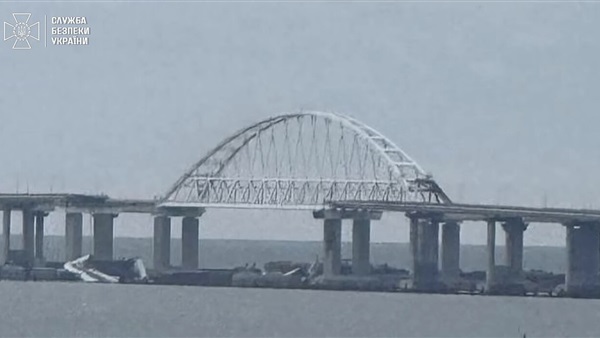
The plans follow a major Ukrainian operation on November 18, 2026, which inflicted extensive damage on the strategic link between Russia and occupied Crimea, dealing a significant military and symbolic setback to Russian President Vladimir Putin.
The attack caused a four-lane roadway and its supporting arch to collapse into the Kerch Strait, substantially restricting Russia’s ability to supply its forces stationed on the occupied peninsula.
According to Ukrainian intelligence, the operation also severely weakened the bridge’s reinforced railway infrastructure.
“The president wants it demolished completely,” a Ukrainian military source told The Telegraph, confirming that additional strikes were being prepared.
Crimean Bridge Remains a Strategic Military Target
The reported preparations reflect Kyiv’s growing confidence in its domestic military capabilities and its determination to maintain pressure on Russian forces.
The complete destruction of the Crimean Bridge would represent a significant political and military achievement for Zelensky as Ukraine seeks to weaken Moscow’s control over occupied Crimea.
However, achieving that objective remains challenging. Previous Ukrainian operations against the crossing have required extensive coordination, while Russian defensive measures around the infrastructure may have been strengthened following the latest attacks.
Also known as the Kerch Bridge, the approximately 12-mile crossing was constructed following Russia’s internationally condemned annexation of Crimea in 2014.
Putin personally inaugurated the bridge in 2018, driving a truck across the structure in an event intended to demonstrate Moscow’s control over the peninsula.
Since Russia launched its full-scale invasion of Ukraine in February 2022, Kyiv has repeatedly targeted the crossing because of its importance to Russian military logistics and the transportation of supplies to forces operating in southern Ukraine.
The November 18 operation reportedly inflicted particularly extensive damage, leaving the crossing’s road infrastructure unusable.
Ukrainian Military Operation Severely Damages Russian Supply Routes
According to military sources, the operation involved extensive coordination between different branches of Ukraine’s armed forces and multiple domestically developed military systems.
Personnel involved in the mission monitored reports and publicly available footage to assess the extent of the damage.
Ukrainian military sources subsequently confirmed that the operation had caused a section of the roadway and its supporting arch to collapse into the waters below.
The railway infrastructure, which was constructed to withstand the considerable weight of freight trains, also sustained significant damage.
Military personnel involved in the operation reportedly learned that Zelensky had personally ordered further action against the crossing.
A British Ministry of Defence intelligence assessment released on Friday indicated that the road section of the Crimean Bridge had been rendered inoperable, although one railway track was likely to remain operational.
The assessment also indicated that the collapsed infrastructure had temporarily obstructed maritime traffic between the Sea of Azov and the Black Sea, pending the clearance of debris from the waterway.
The damage highlights the crossing’s importance not only to Russian military logistics but also to regional maritime transportation.
Ukraine Expands Its Domestic Missile Capabilities
Ukraine’s domestically developed Neptune missile programme has become an increasingly important component of the country’s military capabilities since the beginning of Russia’s full-scale invasion.
Originally developed from Soviet-era anti-ship missile technology, the Neptune gained international recognition in April 2022 when it was credited with sinking the Moskva, the flagship of Russia’s Black Sea Fleet.
The incident demonstrated the effectiveness of Ukraine’s indigenous missile technology and encouraged further investment in its domestic defence industry.
The state-owned Luch Design Bureau has subsequently worked to improve the system, expanding its capabilities beyond its original maritime role.
By 2023, Ukraine had introduced a ground-attack version of the missile, enabling its armed forces to engage a broader range of military targets.
Subsequent developments have further expanded the programme’s operational capabilities, with Ukrainian military sources reporting its use against Russian military infrastructure, including Borisoglebsk Air Base in Russia’s Voronezh region.
Kyiv Considers Increasing Neptune Missile Production
Oleg Korostelov, 77, a Soviet-trained engineer who helped develop the Neptune missile, said production was expected to reach hundreds of units in 2026.
Ukrainian media reports also suggest that Zelensky could redirect some funding allocated to the Flamingo cruise missile programme towards expanding Neptune production.
Such a decision, if confirmed, would reflect Kyiv’s continued efforts to strengthen its domestic defence manufacturing capacity and sustain military pressure on Russia.
Ukrainian military sources believe increased production could significantly expand the country’s ability to conduct future operations.
However, the reported funding changes have not been independently confirmed.
Odesa Mural Reflects Ukraine’s Naval Resilience
As Ukraine continues to develop its military capabilities, a 40-metre mural depicting Neptune, the Roman god of the sea, has appeared on the skyline of Odesa.
Painted on the side of Black Sea Central, an 11-storey hotel, the artwork portrays the mythological figure emerging from the waves while holding a trident, Ukraine’s national symbol.
The mural is intended to commemorate the courage and resilience of the Ukrainian navy. Its imagery also carries a symbolic association with the country’s domestically developed missile programme.
A Ukrainian military source questioned Moscow’s expectations that its attacks on Ukrainian bridges and energy infrastructure would not provoke retaliatory operations against Russian targets.
The reported plans to completely disable the Crimean Bridge underscore its continuing strategic and political significance in the Russia-Ukraine war.
While Kyiv appears determined to undermine Moscow’s military supply network, the effectiveness of Russian defences and the operational condition of the remaining railway infrastructure will remain important factors in determining the outcome of any future operation.
The document is available for donwload using subscriptions only
DOWNLOAD THE DOCUMENT