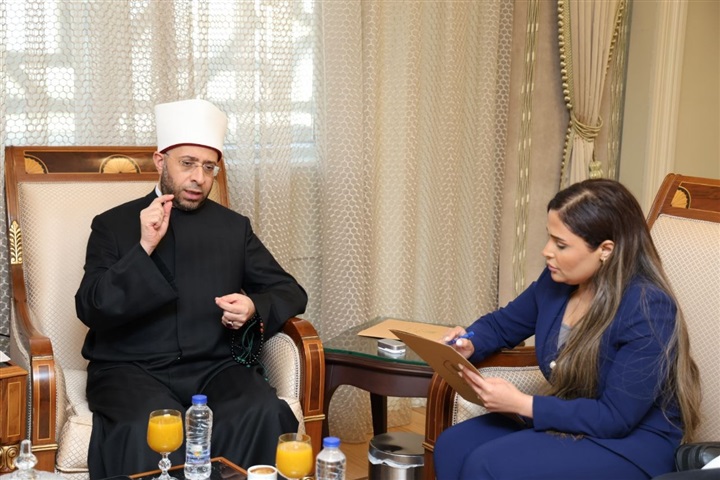
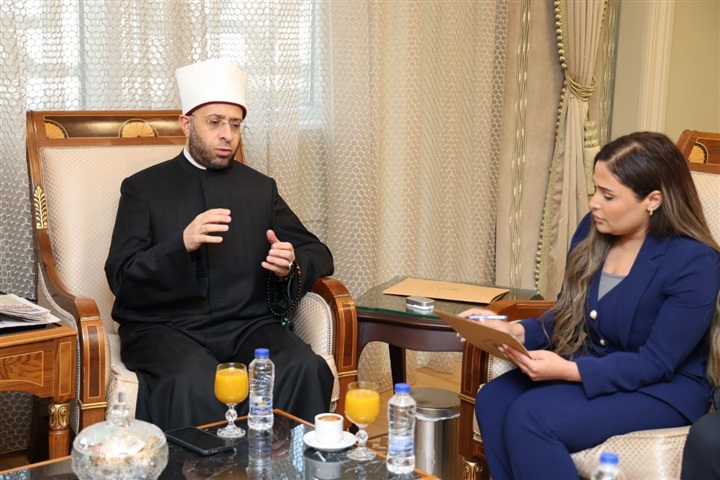
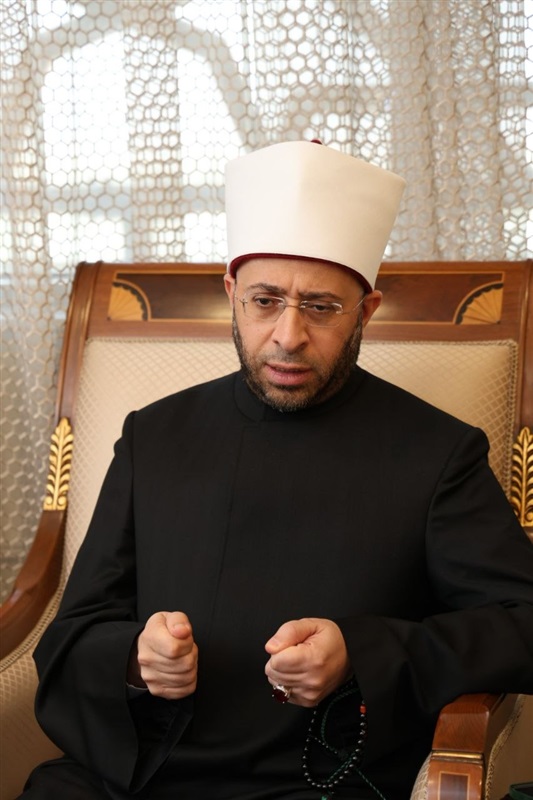
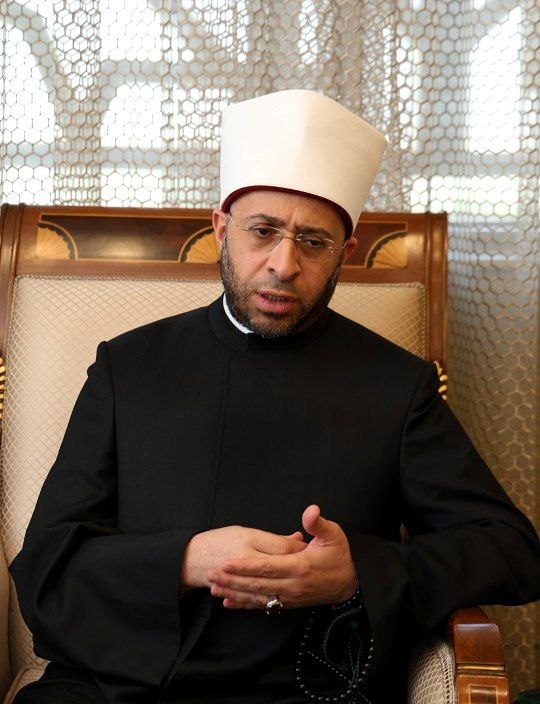
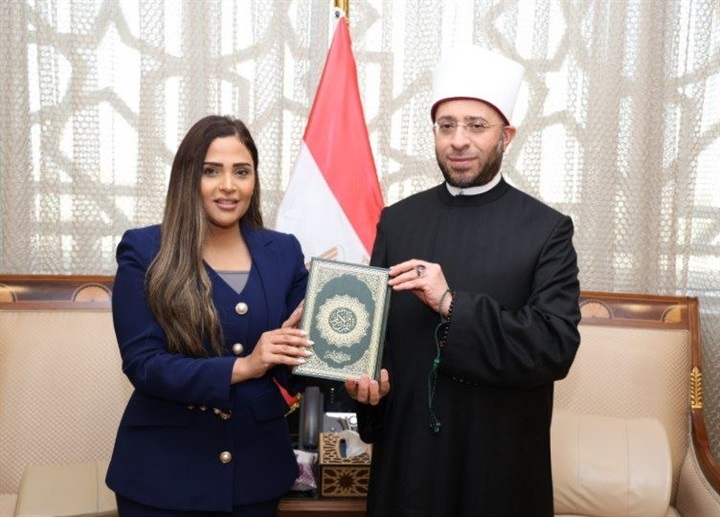
Minister of Awqaf in an Interview with The Reference: “Sunni Sufism, Tempered by Knowledge, Is the Essence of Egyptian Religiosity and Part of Our Cultural DNA for 1,400 Years
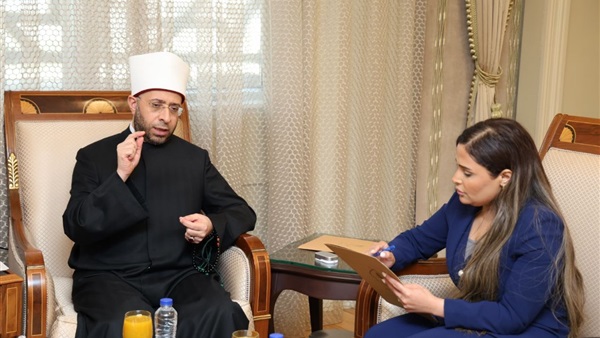
In an interview with The Reference that goes beyond the
confines of conventional religious outreach, Dr. Osama Al-Azhari, Minister of
Awqaf, addresses issues closely tied to Egyptian identity and the future of
religious discourse. He presents readers with an integrated vision for restoring
the authentic Egyptian character, confronting both religious and irreligious
extremism, developing the individual, and building civilization. The interview
examines Sufism as one of the deeply rooted components of the Egyptian
consciousness, as well as the state’s project to develop the mosques of Ahl
al-Bayt—the Prophet’s family—and Historic Cairo, with all the religious,
cultural, and civilizational dimensions this entails. The Minister also
explains his vision for renewing religious discourse without compromising
established principles of Islamic law. He further reveals new details about
“Dawlat Al-Tilawa” (“The State of Quranic Recitation”) and the Ministry’s plans
to engage younger generations digitally, extending all the way to artificial
intelligence. On a personal level, he speaks about his relationship with
reading, his prayer beads, his library, and his diverse intellectual interests.
The full interview follows:
• The Reference: The Ministry of Awqaf places
considerable emphasis on preserving Egypt’s religious character. How is the
Ministry working to achieve this amid global changes?
Dr. Osama Al-Azhari: This question goes back to one of
the main pillars of the Ministry of Awqaf’s strategy. Since assuming
responsibility, we have set four specific objectives around which all the
Ministry’s activities revolve, whether through the work of imams and preachers
or through seminars, lectures, and religious lessons.
The first objective is to extinguish the flames of
religious extremism, combat extremism, and dismantle its ideas by ensuring that
all the activities of imams operate within this framework.
The second pillar is to extinguish the flames of the
opposing form of irreligious extremism. We identified manifestations of
behavioral decline among Egyptians, in coordination with nine government
ministries, and arrived at 41 behavioral issues where work is needed to restore
identity. These include driving against traffic, exceeding speed limits,
running red lights, using mobile phones while driving, throwing stones at
trains, cheating in examinations, bullying, harassment, treating tourists in an
undignified manner, electronic gaming and digital addiction, among others.
The third pillar is developing the individual, and the
fourth is building civilization.
• How is the Ministry working to develop the individual
and restore the features of the authentic Egyptian character?
We began by examining all the works that could help trace
the changes that have occurred in the Egyptian character over the past century,
such as Galal Amin’s Whatever Happened to the Egyptians? Changes in Egyptian
Society from 1950 to the Present; Azza Ezzat’s The Secret of Transformations in
the Egyptian Character; Milad Hanna’s The Seven Pillars of the Egyptian
Character; Ahmed Okasha’s Anatomy of the Egyptian Character; Gamal Hamdan’s
encyclopedia; Shafiq Ghorbal’s The Message of Egypt and The Making of Egypt;
Hussein Mo’nis’s Egypt and Its Mission; and others.
Through this examination, we began to identify the
principal keys to the authentic Egyptian character, which is founded on
upright, tolerant, gentle, and accommodating religiosity—a religiosity rich in
morality, love, and altruism; quick to forgive and overlook offenses; and
characterized by gentleness, ease, and friendliness.
From there, we began working on this issue. That is why
the convergence between the objective we seek to achieve and this initiative
has made me extremely pleased. God willing, our objectives all serve a single
mission: restoring Egyptian collective memory and reviving the authentic
Egyptian religious identity that Egyptians embraced and established over the
course of 1,400 years, but which began to be distorted by currents of extremist
religious thought in recent decades. God willing, we will succeed in clearing
away the confusion that has arisen.
I can say that the very word “Sufism” has been subjected
to extensive attack and distortion. Sufism, in the sense of spiritual
purification, morality, proper conduct, confronting every manifestation of the
human ego’s harshness, and cleansing the human soul of rancor, envy, arrogance,
suspicion, and animosity—while filling it with gentleness and noble moral
qualities—is, on the one hand, the essence of religion and, on the other, the
approach most closely attuned to Egyptian sensibility, consciousness, and temperament.
Egyptians have long been accustomed to living along the
banks of the Nile, seeing greenery before their eyes, living through
agriculture and growth, and maintaining a connection with the heavens and the
noble unseen since the days of the ancient Egyptians and the Book of the Dead,
through all the successive phases of Egyptian history.
These are the deep-rooted components of the Egyptian
psyche that directly resonate with the pure Sufi tradition, which tells a
person: Beware of arrogance; beware of harboring rancor; do not be negligent;
strive for excellence in everything you do; be mindful of God in all things;
and be beautiful, and you will see existence as beautiful.
Thus, noble moral virtues and Islamic law lie at the
heart of this tradition, particularly as, in just a few days, we will welcome
the first day of Rabi‘ al-Awwal, the month of the Prophet’s birth—a month of
moral virtues.
• Egyptians have a profound attachment to Ahl al-Bayt,
who also hold a special place in Sufi thought. How does the Ministry
distinguish between authentic Sunni Sufism and erroneous practices that have
become associated with it?
The Egyptian approach to religiosity became associated
with the Sufi path just as strongly as it became associated with Al-Azhar
Al-Sharif, which represents knowledge and scholarship. Egyptian Sufism is
founded upon knowledge.
For a thousand years, Al-Azhar Al-Sharif has succeeded in
preserving this identity and ensuring that it has always remained balanced by
the measure of knowledge. Sufism in the Egyptian consciousness has never been
separated from knowledge. Knowledge safeguarded Sufism against every
manifestation of deviation and kept it firmly connected to the profound essence
of the noble Sharia: revolving within its orbit, drawing from it, aspiring
toward it, and being illuminated by its light.
Egyptian religiosity, infused with the spirit of Sufism,
remained imbued with the spirit of knowledge. Sufism thus became the authentic
Egyptian spiritual tradition, while knowledge became its guardian against every
form of distortion. Consequently, as Egyptians, we have succeeded in living the
meaning of Sufism and expressing love for Ahl al-Bayt without deviating either
toward estrangement and harshness or toward excess and exaggeration.
• How do you view President Abdel Fattah El-Sisi’s
attention to the mosques of Ahl al-Bayt and their development?
President Abdel Fattah El-Sisi’s care for the mosques of
Ahl al-Bayt is evident in the generous attention given to the Mosque of
Sayyidna Al-Hussein, including its development and inauguration; the attention
accorded to the mosques of Sayyida Zainab and Sayyida Nafisa; the ongoing care
for the Mosque of Sayyida Aisha bint Ja‘far Al-Sadiq; as well as Masjid Misr,
Al-Ali Al-Azim Mosque, Al-Aziz Al-Hakim Mosque, and the extensive attention
devoted to Egypt’s major mosques. All of this underscores that commitment.
I would also point here to the Mosque of Sayyida Ruqayya,
where there is a very small gravestone belonging to Imam and Hadith scholar
Muhammad Murtada Al-Zabidi. It is located inside the mosque; before entering
the shrine, you will find his very small gravestone on the right.
• To what extent have President Abdel Fattah El-Sisi’s
directives regarding the development of the mosques of Ahl al-Bayt and historic
shrines helped restore recognition of this dimension of the Egyptian character?
The President continuously follows all the efforts of the
Ministry of Awqaf, whether in the religious sphere or elsewhere. There is ample
evidence of this, including the President’s gracious attendance at the
graduation of the first cohort of preachers and imams from the Egyptian
Military Academy, as well as his attendance at the graduation of the second
cohort. He has also issued continuous directives to improve the competence of
imams, refine standards, select the finest and best-qualified candidates—those
possessing merit, competence, and capability—and raise their level across all
fields.
There is also constant attention to Ahl al-Bayt, as well
as to the Awqaf Authority and the development of its operations in a manner
that achieves the highest possible benefit for the Authority, develops its
assets, and ensures their sound investment. In truth, the President’s sustained
attention and continuous follow-up constitute the greatest support, God
willing, for the success we can achieve.
• In recent years, we have indeed witnessed unprecedented
development of the mosques of Ahl al-Bayt. What do these projects signify for
the state?
These projects are an important indication of the
Egyptian state’s vision and President Abdel Fattah El-Sisi’s vision. It is a
profoundly insightful vision, closely aligned with reality and fully cognizant
of the Egyptian psyche and the psychological and historical contours of the
Egyptian consciousness.
It represents generous support for this upright approach
to understanding religion and for presenting the finest expressions of Egyptian
religiosity through the gracious care devoted to the resting places and mosques
of Ahl al-Bayt.
Two weeks ago, we celebrated the renewal of the
furnishings at the Mosque of Sayyidna Al-Hussein. This is one manifestation of
the celebration, reverence, and appreciation accorded to major mosques and
their preservation, ensuring that the houses of God remain available to serve
the guests of God at the highest possible standard.
The point is that this reflects a profound awareness on
the part of the Egyptian state of this cultural “genetic code” of upright
religiosity that Egyptians have embraced.
• Is the development of the mosques of Ahl al-Bayt solely
about preserving heritage, or does it have a broader civilizational and
cultural dimension?
Certainly. When we view the scene from a broader
perspective, we find that just as the President has shown concern for the
Mosque of Sayyidna Al-Hussein and the mosques of Sayyida Zainab and Sayyida
Nafisa, he is now giving attention to the Historic Cairo project.
There is comprehensive development of the Citadel
district and the Citadel of Muhammad Ali, comprehensive development of the area
surrounding the Mosque-Madrasa of Sultan Hassan, and comprehensive development
of the cemetery of Imam Jalal Al-Din Al-Suyuti, together with the historic
domes and minarets surrounding it.
There is also comprehensive development of the Sayyida
Nafisa area, transforming it into a world-class destination for visitors. The
restoration and renovation of the Mosque of Sayyida Aisha has likewise been
completed in cooperation with the Ministry of Tourism and Antiquities and the
Mawadda Foundation.
Thus, we are moving from caring for mosques to caring for
ancient and historic landmarks, thereby highlighting the civilizational
dimension.
• Regarding Imam Murtada Al-Zabidi, what does his
civilizational project represent?
Al-Zabidi was an astonishing figure, truly a marvel. He
was born in India and received his education there. He then traveled to Zabid
in Yemen, where he lived for several years and from which his nisba,
“Al-Zabidi,” was derived. He subsequently spent some time in the Two Holy
Mosques before coming to Egypt, where he lived for the remainder of his life
and ultimately died.
It was in Egypt that his brilliance fully emerged. He
took Al-Qamus Al-Muhit (The Comprehensive Dictionary) by Imam Al-Firuzabadi—one
of the most complex dictionaries of the Arabic language—and produced an
extensive commentary on it entitled Taj Al-Arus fi Sharh Muhkam Al-Qamus (The
Bride’s Crown: A Commentary on the Definitive Dictionary), which was published
in Kuwait in 40 volumes. This constituted the first pillar of his
civilizational project: the philosophy of language.
He then turned to the field of ethics, writing a
commentary on Ihya’ Ulum Al-Din (The Revival of the Religious Sciences)
entitled Ithaf Al-Sada Al-Muttaqin fi Sharh Ihya’ Ulum Al-Din in 15 volumes. He
subsequently devoted attention to Hadith studies and scholarly documentation.
He died in Egypt in 1205 AH, eight years before the
arrival of the French Expedition. One indication of this remarkable man’s
stature is that a German researcher named Stefan Reichmuth wrote a book about
Murtada Al-Zabidi entitled The World of Murtada Al-Zabidi. He devoted 17 years
to studying the Imam’s life, while his university in Germany provided him with
€3 million to fund his research on Al-Zabidi.
This reinforces the very point we are discussing: Hadith
scholarship taught him verification and documentation; linguistic scholarship
taught him how to understand and make others understand; and ethical knowledge
was preserved through the discipline of scholarship. It was a comprehensive
civilizational project.
• And what about Sheikh Hassan Al-Attar and his
civilizational project?
He was followed by Sheikh Hassan Al-Attar, Sheikh of
Al-Azhar, whose civilizational project centered on technology. Al-Attar was not
merely a scholar of Islamic law; he also authored works on engineering,
astronomy, medicine, arithmetic, and mathematics, the manuscripts of which
remain available to us.
Following the French Expedition, he embarked on extensive
travels throughout the Islamic world, after which he returned to Egypt and
remained there until his death in 1250 AH.
When he entered the French laboratories, he realized that
he understood the underlying principles upon which the inventions in those
laboratories were based, but he had never thought of transforming those
principles into practical instruments. The “know-how” was there, but what was
missing was one further step: converting the rational sciences through which
design and invention were understood into an actual instrument.
From this point, Hassan Al-Attar began directing Rifa‘a
Al-Tahtawi to Paris to acquire certain essential keys to knowledge, while also
sending his student Ayyad Al-Tantawi to Russia to acquire other essential keys.
His civilizational project therefore centered on
technology, invention, and the machinery that could be produced on the basis of
a profound understanding of the rational and mathematical sciences.
• How does the Ministry confront ideas that attack
Egypt’s Sufi heritage? And what are the Sharia guidelines governing visits to
shrines?
We confront them through knowledge, clarification,
exemplary conduct, and honorable role models.
The Sharia guidelines require that such visits be clearly
inspired by Prophetic guidance and conducted with proper decorum, reverence,
and respect, without commotion, exaggeration, harshness, or transgression.
A visit that fills people’s hearts with spiritual
presence, reverence, and beauty, while safeguarding their consciousness against
any infringement upon the sanctity of divine oneness—and at the same time
preserving complete love for the righteous, the saints, and those endowed with
spiritual knowledge—is the balance by which we operate and which, by God’s
grace, Egyptians have maintained throughout history.
• Let us turn to the program “Dawlat Al-Tilawa,” a
project that has achieved tremendous success. What does it represent for the
Ministry?
“Dawlat Al-Tilawa” is no longer merely an initiative of
the Ministry of Awqaf; it has become an Egyptian national project. By God’s
grace, it has succeeded in instilling in Egyptians a profound sense of pride
and joy in the capabilities and talents we possess. It has brought Egyptian
families together once again around their television screens to watch a
competition showcasing the most creative and melodious talents and voices,
displaying their artistry in the recitation of the Glorious Qur’an.
It has also revived the traditions of the authentic
Egyptian school of Qur’anic recitation, religious chanting, supplication, and
devotional praise, which preserve the Egyptian consciousness. With proper care,
we hope once again to produce a generation like Sheikh Muhammad Rif‘at, Sheikh
Al-Minshawi, Al-Husary, Abdel Basit, and those other great masters.
At last year’s Laylat Al-Qadr celebration, attended by
the President, we celebrated the conclusion of “Dawlat Al-Tilawa” and announced
at the time that the program had reached 3.7 billion views. The latest update
is that it has surpassed five billion views over the past several months.
We have begun the competition procedures for the second
season and have found that participation in the second season is considerably
greater, while the new talents are truly extraordinary.
• Did you expect such success for a program of this
distinctive kind?
No. Whatever success we had hoped for or expected was
exceeded many times over by what was actually achieved. Praise be to God; this
is an immense blessing from our Lord.
• On a personal level, what does the “Dawlat Al-Tilawa”
project mean to you?
What makes me happiest about “Dawlat Al-Tilawa” is that
it has once again created ambassadors for Egypt. I regard these voices as
ambassadors for Egypt abroad. They represent one form of projecting Egyptian
identity to the world.
• How does the Ministry address younger generations? And
what role do digital platforms play in preparing new generations and religious
preachers?
Discourse directed toward younger generations has
parameters and distinctions that differ enormously from conventional,
traditional discourse. Since assuming responsibility, we have paid close
attention to the Ministry of Awqaf’s digital platform and worked intensively on
it. Within a few months, we succeeded in launching it in the presence of the
Prime Minister at the Cabinet’s Media Center. Since then, we have continued
developing the platform and adding new sections.
We have paid particular attention to children. At the
upcoming Book Fair, there will be major surprises in the Ministry of Awqaf’s
outreach to children, in addition to the many seminars held at mosques
throughout the country that support children’s activities, particularly during
the summer.
We have also devoted attention to female preachers and to
discourse directed toward Egyptian families and women, thereby caring for
Egyptian children from the earliest stages of their upbringing.
The coming period, God willing, will see all electronic
content on the platform translated into a number of languages, foremost among
them English, followed successively by other languages.
We are also working on launching a dedicated application
for the Ministry of Awqaf and studying the creation of an
artificial-intelligence-based tool that would provide an interactive
conversational mechanism on the Ministry’s platform similar to “ChatGPT.” We
are also examining the development of a dedicated Ministry of Awqaf chatbot
containing all the authoritative sources in our Islamic heritage, so that we
can be confident that artificial intelligence generates answers reflecting a
rigorous and disciplined scholarly methodology.
• How does the Ministry view the concept of renewing
religious discourse? Are there indications of a distinctively Egyptian
religious discourse emerging in the future?
Renewal is a great and significant principle, but it must
be translated into practical procedures and mechanisms. The first practical
realization of this concept was the identification of the four pillars we
discussed: extinguishing the flames of religious extremism and irreligious
extremism, developing the individual, and building civilization.
Each of these pillars is translated into a set of
activities on the ground as well as digital initiatives. We have already begun
working in practice to produce what may properly be called renewal. Perhaps the
first fruit that embodies this approach is “Dawlat Al-Tilawa,” and through all
the efforts we are making, we hope that we are moving in this direction.
• What is the difference between renewal and undermining
established religious principles?
Imam Sheikh Muhammad Abu Zahra, may God have mercy on
him, used to say: “Renewal means removing from religion the erroneous
understandings and bewildering misconceptions that have become attached to it,
so that it may return pure as it was in its origin and clear in its essence.”
Renewal means restoring the framework that expresses the
higher objectives of Islamic law to the sphere of human conduct and
demonstrating to people the noble virtues and merits of the Sharia.
By contrast, violating or belittling the methodology of
Islamic thought and the objectives of the Sharia—or attacking them through
extremist and terrorist ideology while claiming such conduct to be an
expression of religiosity—is a squandering of the objectives of the Sharia, not
renewal.
• Let us turn to the personal side. What is the
significance of the prayer beads you always make a point of carrying?
The significance of the prayer beads lies in my profound
belief and absolute certainty that one’s appointed time may come at any moment,
and that the one thing I regard as my gateway to hope and to approaching God
when life comes to an end is abundant remembrance of God.
That is my refuge, my sanctuary, and my shelter. This is
why I remain constantly accompanied by my prayer beads, because they are my
greatest aid in maintaining continual remembrance of God in preparation for the
day of departure.
• The books in your car generated considerable
discussion. What is the story behind your “mobile library”?
I was surprised by what was circulated, and my first
reaction was one of astonishment: How did they know which books were in the
car? Then it became clear that they had appeared only fleetingly.
The truth, however, is that from my earliest upbringing,
a commitment to reading and a passion for it were instilled in me.
Consequently, wherever I am, books surround me on every side—even where I sleep
and where I live.
I have designated a special place for my library because
it is too extensive to be contained in a single house or location. It is
distributed across several premises of its own, while I continuously work to
arrange, classify, and catalogue it.
At times, I constantly need to consult a number of books
or read about certain issues and areas of research, yet I do not have enough
time to travel to the library’s premises. As a result, my iPad has become a
mobile library containing approximately 6,000 or 7,000 book titles that are
particularly necessary and that I need to consult regularly.
• To conclude our interview, what are the most important
fields you make a point of reading in, particularly those unrelated to your
work?
Psychology, law, philosophy, and poetry—I am passionately
devoted to poetry—as well as astronomy and the astronomical sciences, and I
follow every new development in those fields because they have a profound
effect on certainty and reverence for God.
I am also interested in philosophy and literature in its
various schools, whether ancient classical literature, contemporary literary
schools, or literature in translation.
History, too, is one of the important streams of knowledge that I never tire of reading, because it illuminates humanity’s path toward the future.