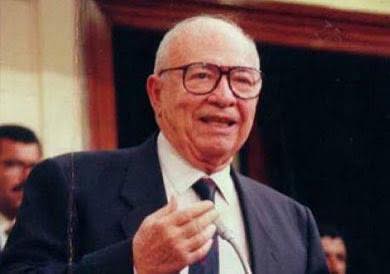
The Red Major
That was the nickname his
colleagues in the July Revolution Command Council used for him, because of his
affiliation at the time with socialist thought.
When I met him for the first
time, I was a young journalist, not yet twenty-three years old. I had come from
Upper Egypt, dreaming of freedom and justice, and of the poor people’s right to
a decent loaf of bread, a drink of water, and free medical care worthy of their
suffering.
I found no door open to me except
that of the left, wide open.
I am the son of the poor, frail
in body and spirit, panting with jealousy for my country.
The great Khaled Mohieddin
received me in his office at 1 Karim El-Dawla Street.
I was proud of myself, but not to
the point of imagining that I would meet face to face with the leader:
the Red Major, a member of the
July Revolution Command Council, and the leader of the left.
He greeted me warmly, as if to
calm my nerves, saying:
“I’ll see you tomorrow at nine,”
and ended the meeting.
I left dissatisfied; I had
thought the interview would last longer, that he would ask about my
circumstances, how I was living in Cairo after leaving my hometown in Upper
Egypt, following a summons from the newspaper to work as its correspondent at
the Ministry of Interior.
I assumed he would ask me how I
would deal with this vital and important institution, and that he would brief
me on the red lines I should not cross.
But the meeting lasted no more
than two minutes and ended with an appointment the next morning.
I spent the night thinking: what
would Professor Khaled say to me?
I kept preparing logical answers
to his presumed questions.
In the morning I went early,
drank my coffee from the hands of Uncle Abdu, may God have mercy on him, and
waited with Huda, the leader’s secretary, in his office.
Professor Khaled arrived, signed
some papers quickly, then took me with him.
We went down the staircase
leading to Karim El-Dawla Street, where the party headquarters stands, then got
straight into his car:
a green Lada station wagon.
I do not know why I had imagined
that the leader’s car must be a black Mercedes, but my expectations were
disappointed.
In the car, Professor Khaled said
to me:
“Are you married?”
I said, “Yes.”
“And do you have children?”
I said, “I have one daughter.”
When he asked me her name, we had
already arrived at the door of the Cairo Governorate building.
The governor was waiting for the
leader, and Professor Khaled immediately said to him:
“We have brought this young man
from Upper Egypt to be the newspaper’s correspondent at the Ministry of
Interior. He is married and has a little girl, so we want an apartment for him
in the journalists’ housing.”
I was astonished, as was the
governor, Major General Omar Abdel Akher, who said to him:
“Have you yourself come, Your
Excellency, just to make this simple request?”
Immediately, the governor
completed the administrative procedures, and within two hours I had the key to
the apartment in historic Cairo, accompanied by an exemption from the down
payment.
A simple lesson in its
procedures, profound in its meanings.
It was the lesson the leader gave
me in my very first days in the court of Her Majesty the Press:
how a leader and official
preserves the dignity of those who work with him, even if they are the age of
his own children.
Only a few years had passed
before I clashed, early in my career, with the Minister of Interior, Hassan
Al-Alfi, during his battle with Al-Shaab newspaper.
In a report I had addressed
points of weakness in the minister’s position in that battle, which prompted
him to issue instructions barring me from entering the ministry.
I was not allowed back in until
the late Major General Raouf Al-Manawi intervened to resolve the situation, on
the condition that I inform the leader Khaled Mohieddin of the minister’s wish
to visit him at his office in the ministry as soon as possible.
I informed Professor Khaled of
the minister’s wish to meet him; he did not hesitate.
We set the appointment quickly
and went together.
I did not know they were plotting
to drive a wedge between me and the leader, so that I would leave my post as
Al-Ahali newspaper’s correspondent at the Ministry of Interior and be replaced
by someone easier to deal with.
Major General Raouf Al-Manawi
tried to persuade Professor Khaled that the meeting should take place without
my presence.
I could see the logic in that;
perhaps there were things I should not know.
But I was surprised when
Professor Khaled insisted on my presence and gently refused the general’s
request, saying:
“I hide nothing from party
members and cadres, especially the youth.”
That was a reference to me, as I
was then the youngest member of the party’s Central Committee.
At the meeting, what Professor
Khaled had expected happened: the minister reproached me for my stance and
hinted at the necessity of replacing me.
Professor Khaled immediately
sprang to my defense in a way I had not expected, especially in the face of the
Minister of Interior.
At the end of the meeting, he
explained to the minister the method of selecting correspondents at Al-Ahali
newspaper, the official mouthpiece of the Tagammu Party, and that a
correspondent could not be replaced except according to specific rules. He added
that he would personally sit with me to urge greater cooperation, that he
personally vouched for me, and that he guaranteed my good performance.
I left the meeting proud of my
leader, my party, and my newspaper, resolved to give everything I had for their
elevation.
That was the second lesson the
leader taught me:
stand by the reporter as long as
he is right; do not abandon him unless he errs in telling the truth—not the
other way around.
Years passed, and one day I saw
the other face of the leader.
He was very angry with me. He
summoned me and said harshly:
“What did you write today?”
I said, “I wrote a report about
the arrest of a group of police officers and soldiers who were selling
ammunition and state-owned weapons to terrorists in Upper Egypt.”
He asked sharply:
“Is this confirmed?”
I said, “My information confirms
it. At least three officers were arrested two days ago and are being held in
Beni Suef General Prison. I know one of them personally.”
He said:
“The minister called me angrily
and said the news is completely unfounded, and that he will hold a global press
conference today to deny it.
Tomorrow you will submit your
resignation immediately, or we will issue a decision to dismiss you.”
I left his office utterly
shattered.
That was how I felt: that my
support in life, after God, had abandoned me.
He was not alone; everyone cut
off contact with me out of fear of the minister.
I entrusted my fate to God,
knowing I was right.
I awaited the issuance of my
death sentence.
At five in the afternoon I spoke
with my friend Mohamed Salah Al-Zahar, the news correspondent at the ministry.
When his voice reached me
laughing, I felt reassured.
He said:
“Divine providence has saved you.
The minister canceled the conference and contented himself with a statement in
which he acknowledged the incident and announced the arrest of twenty-eight
officers and soldiers.”
The cancellation of the press
conference and the Minister of Interior’s full disclosure of the truth to
public opinion in a statement have a long story, which I later learned from
Major General Omar Suleiman, may God have mercy on him. Perhaps one day I will
recount it in full.
I breathed a sigh of relief.
In the morning I met Professor
Khaled with the face I knew. He squeezed my hand and wished me success with a
gentle smile that has never left my imagination. He even awarded me a bonus of
one thousand pounds—
and you know what that amount
meant at the time.
This was the third lesson the
leader taught me:
I will support you as long as you
are right, no matter the cost to me; but I will be angry with you and abandon
you if you are lying, negligent, or spreading rumors that harm national
security.
Days went by, and the major deal
between the state and the religious-violence groups came.
I stood alone opposing it,
warning of its exorbitant cost.
The leader Khaled Mohieddin and
Dr. Refaat El-Saeed were the first to support me—
to the extent that Refaat
El-Saeed entered into a sharp confrontation with Major General Habib Al-Adly at
the time, on the front page of Al-Ahali newspaper, when he threatened to arrest
me.
That, too, is another story,
telling of the battle of the Tagammu Party and Al-Ahali newspaper
with the Ministry of Interior and
its minister, Habib Al-Adly, over the assessment of “the deal to halt violence
between the state and the religious-violence groups at the time.”
I had written extensive studies
on the subject,
published in two books:
one by Merit Publishing House,
entitled
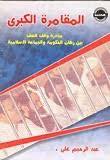
Risk in the Government’s Deal
with the Violence Groups,
and the other by Al-Mahrousa
Publishing House, entitled
The Initiative to Halt Violence:
Between the Government’s Bet and the Islamic Group.
Perhaps one day I will have the
time to write about its labyrinths; there is much in them that deserves to be
told.
Days passed, and the facts were
revealed.
Those lessons were not the last
that the two men taught me:
Khaled Mohieddin and Dr. Refaat
El-Saeed,
but they were perhaps the most
important.
There are many other lessons that
still dwell within me, which I continue to recount and teach to my children
every day.
Khaled Mohieddin passed away
without knowing that I named my only son “Khaled” after him.
When I took my first steps in the
leftist current, I chose the name “Khaled” as my nom de guerre in the first
clandestine organization I joined.
So peace be upon you, leader,
and greet our people there,
and walk gently,
and remember us if time allows.