From Alamein to the Heart of the Regional Scene: Dalia Abdel Rahim Writes on the Foreign Minister’s Vision of Regional and Global Developments

Not every battle is fought on the front lines. Some battles are quieter, yet far more consequential—waged across negotiating tables, where every word is carefully crafted because it may alter the fate of entire peoples. At a regional moment in which competing projects of influence intersect with security concerns, and maps being drawn vie with others being erased, Egyptian diplomacy appears to be performing one of its most complex roles in years: navigating the minefields of politics not merely to observe events, but to help shape their contours.
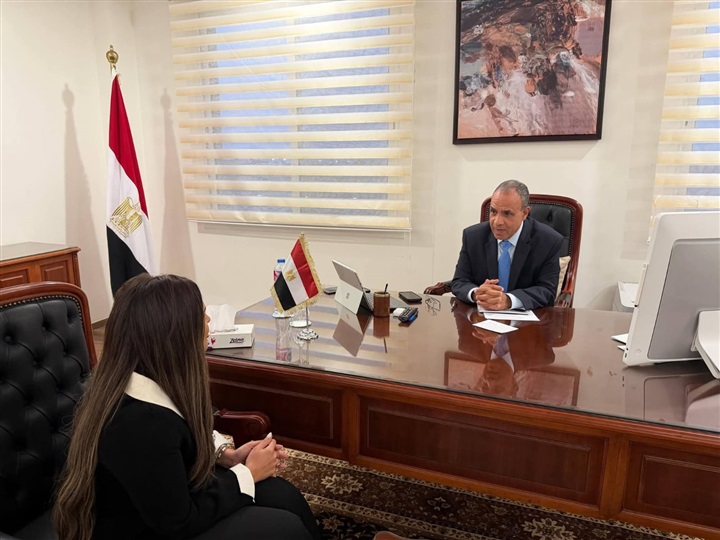
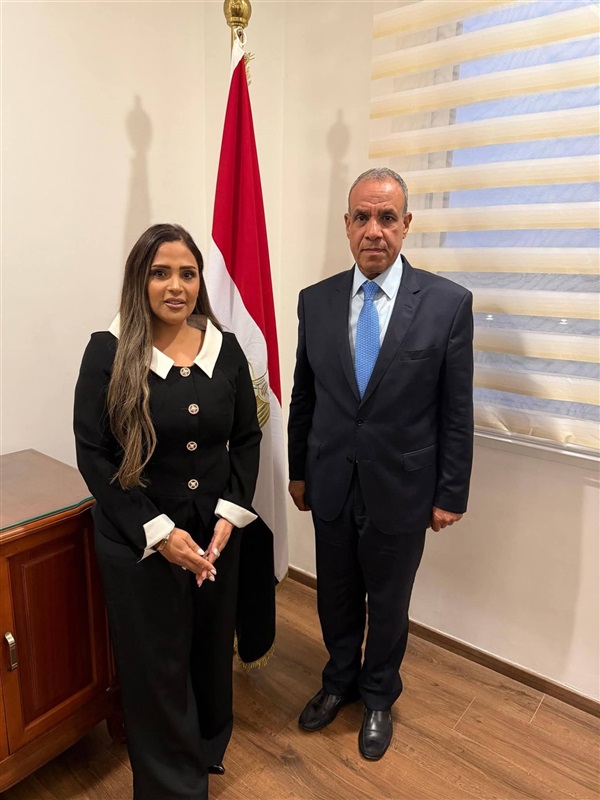
At this exceptionally sensitive juncture, I met with Minister of Foreign Affairs and Emigration Dr. Badr Abdelatty at the Cabinet headquarters in the city of Alamein. It was not a meeting intended to sound out passing positions or record statements of the moment, but rather an attempt to gain insight into the mind directing a fundamental part of Egypt’s foreign-policy engagement at a time when the region is experiencing unprecedented strategic fluidity, old certainties are receding, and the rules of the emerging regional order have yet to take shape amid the ruins of unresolved crises and others that could still ignite at any moment.
Throughout the conversation, the minister did not speak in slogans, nor did he offer interpretations detached from reality. Instead, in measured terms, he outlined Egypt’s vision of an exceedingly complex landscape: from inter-Arab relations to regional transformations, from the Palestinian cause as the core of the conflict to the Egyptian state’s conviction that diplomacy is not an option to which one turns when wars fail, but rather the option that should never have been absent in the first place.
I left that meeting with a clear impression: what is taking place within the corridors of the Egyptian Foreign Ministry is not merely the management of intertwined files, but a daily effort to safeguard the balance of a region that is teetering, to defend the concept of the nation-state, and to uphold the region’s right to a future shaped by just settlements rather than the logic of force.
It is a battle whose clamor people may never hear, yet it is among the most consequential in shaping what the Middle East will look like in the years ahead.
Arab National Security
The Constant Amid the Changes
If regional transformations are compelling many states to redefine their priorities and alliances, what stands out in Egypt’s vision is its adherence to a constant that has remained unchanged despite the shifting landscape: Arab national security is not a collection of separate files, but a single, integrated system, and the stability of any Arab state necessarily has repercussions for the stability of the region as a whole.
It was from this premise that I asked the minister how Cairo maintains a balance in its relations with its Arab partners, foremost among them the Kingdom of Saudi Arabia and the United Arab Emirates, amid what may at times appear to be differences in their perspectives on certain regional issues.
His answer was unequivocal. He affirmed that Egypt enjoys very good relations with the various Arab states, and that Cairo does not formulate its foreign policy on the basis of temporary disagreements or differing positions on a particular issue, but rather from a broader and deeper concept: the unity of Arab destiny. He explained that Egypt regards Arab national security as “an indivisible whole.” Accordingly, any attack targeting an Arab state is not viewed as a matter concerning that state alone, but as an assault on Arab security in its entirety.
Proceeding from this understanding, he stressed that Egypt’s position has remained steadfast in times of crisis and that Cairo has responded immediately to every request made of it in support of its Arab brethren, acting from a sense of responsibility toward its Arab surroundings rather than treating such support as a transient political stance.
It was clear from the minister’s remarks that Egyptian foreign policy rejects reducing inter-Arab relations to the logic of alignments or temporary alliances. States may differ in their assessment of certain issues, but what unites them—from Egypt’s perspective—is greater than any passing disagreement.
For this reason, Cairo does not view the region as an arena of competition among Arab capitals, but as a single space in which one part cannot enjoy stability while another remains engulfed in conflict. That answer provided an entry point for understanding the remainder of the conversation: everything the minister subsequently addressed—the region’s crises, the future of the Middle East, and the priority accorded to diplomatic solutions—rested on a constant that Egypt appears unwilling to relinquish: Arab security is a shared responsibility, and preserving it begins with maintaining the cohesion of the Arab house itself.
A Middle East Whose Contours Have Yet to Fully Emerge
If the discussion of Arab national security revealed the constant from which Egyptian foreign policy proceeds, the next question turned to the greater variable: a regional landscape that is no longer governed by the rules the region knew for decades, but is instead undergoing a transformation whose contours have yet to fully emerge.
I asked the minister: How does Egypt view the talk of reshaping the map of the Middle East? And what are the defining features of its vision for its regional role at this stage?
Dr. Badr Abdelatty did not treat the matter as a settled reality. Rather, he reframed the moment itself, emphasizing that the region remains in a “period of labor” and that talk of final maps or stable balances is premature. The landscape, as he described it, is governed by political and strategic fluidity that makes it impossible to issue definitive judgments or predict the shape of the coming regional order. He therefore explained that Egypt’s priority is not to interpret outcomes that have yet to materialize, but to work to prevent the region from sliding into broader cycles of conflict.
The Future of the Middle East Cannot Be Shaped in the Absence of Its States
Accordingly, Cairo places at the forefront of its efforts the revival of dialogue and the encouragement of the United States and Iran to return to the negotiating table, based on the understanding that continued estrangement and escalation threaten not merely two particular parties but risk opening the door to upheavals whose consequences would extend across the entire region. What was striking in his remarks was not only his emphasis on the importance of negotiations, but also his reference to a lesson that Egypt considers one of the gravest of recent years: arrangements concerning the future of the Middle East cannot be formulated in the absence of the region’s own states.
In this context, he invoked the experience of 2015, considering the exclusion of regional powers from discussions concerning the region’s future to have been a grave mistake that must not be repeated. At this particular point, Egypt’s vision appeared to transcend the management of immediate crises and instead defend a broader political principle: regional stability cannot be the product of understandings concluded by major powers alone. Rather, it must emerge from a genuine partnership in which the states of the region themselves participate, because they are best positioned to understand its complexities and will ultimately bear the cost of any arrangements imposed from outside.
Thus, the minister’s reference to a “period of labor” was not so much an expression of ambiguity as an accurate description of a stage whose ending has yet to be written—a stage in which Egypt believes that the best course is not to wait and see what these transformations produce, but to help guide them through dialogue and diplomacy and by involving the genuine stakeholders in shaping the future of their own region.
The Palestinian Cause Is at the Core of the Crisis
Where the Test of Stability Begins
As the circles of conflict widened, another question inevitably arose: Where is the region heading? Are we witnessing the emergence of new balances that may ultimately lead to stability, or are we passing through a transitional phase containing even more complex possibilities?
The minister’s answer differed from many interpretations that reduce the landscape to a single crisis or conflict. He appeared intent on presenting the entire picture, emphasizing that the Middle East is laboring under an interconnected web of crises, none of which can be separated from the others. He spoke of tensions with Iran and the attacks that Gulf states have experienced, before turning to the unresolved crises in Libya, Sudan, Yemen, Lebanon and Syria, and finally to repeated Israeli attacks.
The picture he painted makes clear that the region is not confronting a single crisis, but rather standing atop accumulated layers of crises, any one of which could erupt and send shock waves through its surroundings. Yet amid this multitude of crises, he singled out the Palestinian cause—not as merely one issue among many, but as the core of the crisis that continues to cast its shadow over the entire region. His message here was clear: regardless of the number of initiatives undertaken, and however successfully some flashpoints may be contained, the absence of a just settlement of the Palestinian cause means that the underlying causes of instability will remain and that peace will continue to be fragile and liable to collapse at any moment.
The Real Key to Any Regional Order
At this point, the philosophy guiding Egypt’s actions became even clearer. Cairo does not approach the Palestinian cause merely as a political legacy or historical commitment, but as the real key to any stable regional order. It therefore does not view attempts to address other crises in isolation from Palestine, because treating the consequences while leaving the cause untouched cannot produce lasting peace.
From this standpoint, the minister affirmed that Egypt’s role will remain pivotal in advancing de-escalation and reviving pathways toward a political solution, based on the firm conviction that the region’s security will not be achieved by managing conflicts, but by eliminating their root causes.
His defense of the Palestinian cause was neither emotional rhetoric nor a conventional position, but a strategic reading of the Middle East’s future—a reading that holds that the region may succeed in containing disparate crises, but will never attain genuine stability so long as Palestine remains outside the framework of a just and comprehensive solution. Perhaps this is why Palestine has remained, in Egypt’s vision, the compass by which the direction of peace is measured, rather than merely another item on the agenda of crises.
When Force Loses Its Ability to Make Peace
After surveying the map of crises, the next question seemed a natural extension of what had preceded it: if the region is experiencing such a degree of complexity and tension, are military solutions still capable of producing a more stable reality, or has experience demonstrated the limits of force, however great?
The minister did not hesitate in answering. Drawing on the accumulated experience of years of regional crises, he stressed that events themselves have demonstrated the validity of the vision adopted from the outset by the Egyptian state under the leadership of President Abdel Fattah el-Sisi: wars may impose temporary realities, but they do not create peace, and recourse to military force ultimately serves only to complicate crises, widen their scope, and exact a devastating humanitarian price from peoples.
Multiple Scenarios of Escalation
His remarks amounted more to an assessment of the results of experience than to a theoretical proposition. For years, the region has tested multiple scenarios of escalation, yet none has succeeded in definitively closing a file or ending a conflict. On the contrary, many crises have become increasingly intertwined, instability has spread, while political settlements have remained the most conspicuous absence.
He therefore emphasized that dialogue, diplomacy, and political solutions are not slogans Egypt raises in international forums, but a strategic conviction at the heart of its foreign policy. Every step toward negotiation, however slow it may appear, remains less costly than another bullet, and every space opened for dialogue represents another opportunity to spare the region further bloodshed.
Perhaps what distinguishes this vision is that it does not proceed from political idealism, but from a profound understanding of the nature of the Middle East—a region whose history has demonstrated that wars may begin with a decision but rarely end as planned. Settlements, by contrast, despite the patience and complexity they require, are the only means capable of producing sustainable stability. As I listened to him, it became clear that Egypt is not betting on diplomacy because it lacks alternatives, but because it regards diplomacy as the most rational instrument for protecting the region from an endless spiral.
Force may halt a battle, but it does not eliminate its causes. Dialogue, however, when backed by the necessary political will, can address the roots from which conflict emerged. Perhaps this is why a single thread ran through the minister’s answers from the beginning of the conversation: peace is not a temporary position adopted by Cairo in times of calm, but a steadfast strategic choice in which the state’s conviction has only deepened as the region’s experiences have demonstrated that the sound of artillery may be the loudest, but it does not have the final word.
When International Law Becomes the Last Line of Defense
How Does Egypt View the Future of Multilateral Diplomacy?
As the conversation approached its conclusion, the discussion was no longer confined to the crises of the Middle East, but broadened to encompass a larger question concerning the shape of the international order itself: in a world where the effectiveness of international institutions is declining and the rules of international law are tested every day, how does Egypt view the future of multilateral diplomacy? And is it still capable of making a difference?
The minister answered from the perspective of Egypt’s history and role, emphasizing that Cairo’s commitment to multilateral diplomacy is not a position imposed by current developments, but an extension of a long-standing trajectory. Egypt was among the founding members of the United Nations, preceded by its participation in the League of Nations—reflecting a deeply rooted belief that international relations should not be governed by the logic of sheer force, but by a system of rules and obligations to which all are subject.
He did not, however, conceal the scale of the challenges confronting this system. He noted that multilateral institutions are passing through an exceptionally difficult period and that the world is witnessing a disturbing decline in respect for the principles of international law, something clearly reflected in a number of crises, foremost among them the situation in the Gaza Strip. When he spoke of Gaza, his remarks extended beyond the humanitarian tragedy itself to what it represents as a genuine test of the international system’s ability to uphold the principles on which it was founded. He described what is taking place as systematic killing and a man-made famine, at a time when the international community stands unable to enforce respect for the law or halt violations.
Then came one of the clearest messages of the conversation, when he observed that the world is no longer confronting merely a double standard, but rather, in his words, “hundreds of standards” that vary according to the parties and issues involved. This, he argued, threatens confidence in the international system itself and raises profound questions about the future of international justice if rules are applied selectively.
Force as the Sole Reference Point in Relations Between States
Despite the bleakness of this picture, his remarks did not convey despair over international institutions, but rather a call to uphold them more firmly than ever. The more international law is undermined, the greater the need to defend it, because the alternative, as he explained, is not a more just system, but a world governed solely by balances of power—a world in which rules disappear and the weak are left without protection.
At that moment, Egypt was defending not merely the mechanisms of multilateral diplomacy, but a broader idea: that however complex the world may be, it cannot remain stable if it loses faith in the law, nor can it achieve genuine security if force becomes the sole reference point governing relations between states. Perhaps this was the deeper message at the conclusion of the conversation: in Egypt’s vision, diplomacy is not merely an instrument for managing crises, but an ongoing defense of an international order founded on legitimacy and law, because the cost of that order’s collapse would not be confined to the Middle East, but would affect the entire world.
Al-Bawaba Medal of Respect
In some interviews, the value of a conversation lies not only in the answers a public official provides, but also in what it reveals about the way a state thinks as it confronts a defining moment in its own history and that of its surroundings. This was what the meeting represented: a measured reading of Egypt’s vision at a time when turmoil is intensifying and wisdom is becoming an increasingly rare commodity.
It was from this perspective that Al-Bawaba News Foundation recognized the importance of meeting with the minister at this particular juncture and presenting the simplest form of well-deserved recognition to Minister of Foreign Affairs and Emigration Dr. Badr Abdelatty by awarding him the “Al-Bawaba Medal of Respect,” in appreciation of the exceptional diplomatic effort being devoted to managing one of the Egyptian state’s most complex and sensitive portfolios, and in the belief that there are men who work in silence, yet what they accomplish transcends the boundaries of that silence to shape the future of an entire nation and region.