China's Nuclear Arsenal: Bolton Warns Trump's Diplomacy Leaves U.S. Unprepared
Monday 23/November/2026 - 04:22 PM
Ahmed Seif El-din
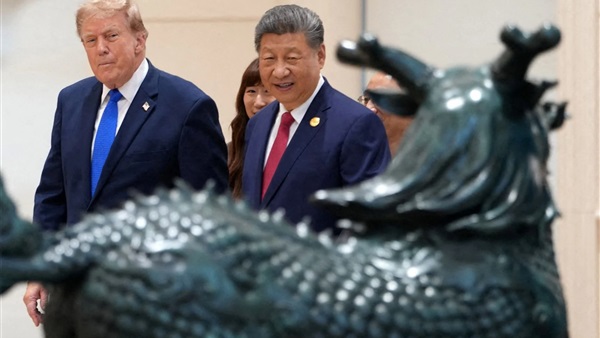
China's nuclear arsenal is expanding rapidly, creating what former U.S. national security adviser John Bolton describes as a fundamental challenge to American security that President Donald Trump has failed to address. Following a trilateral summit with Chinese President Xi Jinping and Russian President Vladimir Putin, Bolton argues that Washington remains dangerously unprepared for a world in which three major nuclear powers compete for strategic advantage.
In an opinion article published by The Telegraph on November 22, Bolton criticized the summit for prioritizing diplomatic appearances over substantive nuclear security discussions, warning that China's growing military capabilities could undermine decades of U.S. deterrence strategy.
Trump-Xi-Putin Summit Raises Questions Over Nuclear Security
The meeting in Shenzhen brought together the leaders of the United States, China and Russia for discussions on international cooperation and strategic stability.
The three leaders reportedly agreed to pursue United Nations reform, increase oil production, disregard the International Criminal Court and reaffirm their opposition to nuclear war.
They also repeated a longstanding principle associated with former President Ronald Reagan: “a nuclear war cannot be won and must never be fought.”
Bolton dismissed these outcomes as largely symbolic, arguing that the summit produced few meaningful commitments on the most pressing international security challenges.
He contrasted the gathering with the historic Yalta Conference of 1945, noting that Britain and France, both permanent members of the United Nations Security Council, were excluded.
For Bolton, the meeting's most significant outcome was not what the leaders agreed upon, but what they avoided discussing.
Xi Jinping and Putin Emerge as Diplomatic Winners
Bolton contends that both Xi and Putin benefited politically from the summit.
Xi hosted the meeting in China, occupied the central position and, according to Bolton, successfully avoided substantial scrutiny of Beijing's expanding nuclear capabilities.
Putin, meanwhile, gained an opportunity to improve his international standing despite the diplomatic isolation Russia has faced since invading Ukraine.
Bolton argues that the summit also reinforced Trump's willingness to engage with the Russian president without securing significant concessions.
Following the meeting, Trump reportedly contacted European leaders gathered in Berlin and conveyed his belief that Putin genuinely wanted peace in Ukraine.
He also questioned whether Western allies should continue providing Kyiv with extensive military assistance.
Bolton interpreted those remarks as evidence that Putin continues to influence Trump's assessment of the war, although that interpretation remains his political judgment rather than an independently established fact.
The Shenzhen meeting was the first encounter between Trump and Putin since their 2025 summit in Alaska.
Ukraine and European Allies Face New Uncertainty
The summit raised additional questions about the future of U.S. policy toward Russia and Ukraine.
Bolton expressed concern that Washington might consider further easing petroleum-related sanctions against Moscow, although no such agreement was confirmed in the article.
He warned that any relaxation could weaken economic pressure on Russia and complicate Ukraine's efforts to resist the invasion.
The three leaders also referenced their countries' historical alliance against fascism during World War II.
Bolton suggested that Moscow could exploit this symbolism because Putin has repeatedly characterized Russia's invasion of Ukraine as an anti-fascist campaign.
Such rhetoric, he argued, could provide the Kremlin with additional propaganda opportunities.
Japan may also have reason to worry about closer diplomatic engagement among Washington, Moscow and Beijing.
Unlike most European countries, Japan faces direct strategic challenges involving both Russia and China, making changes in their relationships with the United States particularly consequential for Tokyo.
China's Nuclear Arsenal Becomes the Central Strategic Challenge
The most serious concern, according to Bolton, is the continued expansion of China's nuclear arsenal without corresponding progress toward arms control.
Although Beijing has not yet reached the United States or Russia in the number of deployable nuclear weapons, its stockpile has grown considerably and exceeds those of other smaller nuclear powers.
Bolton argues that Xi has little incentive to negotiate restrictions while China's nuclear forces remain smaller than those of Washington and Moscow.
In his assessment, Beijing intends to continue expanding its warheads and ballistic missile capabilities until it approaches strategic parity with the two established nuclear superpowers.
Only then, Bolton suggests, might China consider participating in meaningful arms control negotiations.
This interpretation reflects Bolton's assessment of Chinese intentions; the article does not establish that Beijing has formally adopted such a negotiating timetable.
Nevertheless, the expansion of China's nuclear capabilities raises difficult questions about the future of global nuclear security.
From Cold War Deterrence to a Tripolar Nuclear World
During the Cold War, American nuclear strategy was built primarily around competition with the Soviet Union.
Military planners and policymakers debated the number of weapons required for deterrence, how those weapons should be deployed and how the United States could respond if deterrence failed.
The central strategic calculations involved two dominant nuclear powers.
Other nuclear-armed states possessed comparatively smaller arsenals and played a more limited role in American planning.
Bolton argues that the growth of China's nuclear arsenal is transforming this framework.
Instead of a bipolar nuclear system dominated by Washington and Moscow, the world is moving toward a tripolar structure involving the United States, Russia and China.
In his view, this change requires a fundamental reassessment of American defense requirements.
Why Three Nuclear Powers Complicate Deterrence
A tripolar nuclear environment introduces strategic questions that Cold War planning did not fully address.
The United States must consider whether its existing nuclear forces can deter two major adversaries simultaneously.
It must also assess the possibility of overlapping crises involving Russia and China, including situations in which one country challenges American security while the other exploits the resulting pressure.
Sequential confrontations could create different problems, particularly if a prolonged crisis with one adversary affects Washington's ability to deter another.
Bolton argues that these scenarios make traditional calculations increasingly inadequate.
However, a three-power nuclear environment does not automatically invalidate every principle of Cold War deterrence. The scale of the challenge depends on arsenal composition, deployment, survivability, military doctrine and the relationships among the countries involved.
U.S. Nuclear Deterrence and Allied Security at Stake
Bolton believes Washington should prioritize strengthening its nuclear posture rather than concentrating on negotiations with Beijing.
His argument is that effective arms control cannot substitute for credible military capabilities, especially when potential adversaries are expanding their arsenals.
The United States must determine what combination of strategic weapons, missile defenses and deployment arrangements is necessary to preserve deterrence against both Russia and China.
These decisions would also affect American allies.
Countries protected by U.S. extended nuclear deterrence depend on Washington's ability and willingness to respond to major threats.
If American capabilities were perceived as insufficient, Bolton warns, confidence in those security guarantees could weaken.
His proposed approach emphasizes military preparedness, although critics of such a strategy could argue that arms control, transparency and crisis communication remain important tools for reducing the risks of nuclear escalation.
Trump's Foreign Policy Faces a Long-Term Strategic Test
Bolton's criticism extends beyond the Shenzhen summit to what he sees as a broader failure of American strategic planning.
He argues that Trump's emphasis on personal diplomacy and high-profile meetings has not adequately addressed the structural changes taking place in global nuclear competition.
In Bolton's assessment, Xi and Putin understand the challenges facing Washington and are positioned to exploit its uncertainty.
The former national security adviser therefore urges U.S. policymakers to concentrate on the military requirements of a three-power nuclear system rather than expecting diplomatic engagement alone to restrain China's expansion.
The central issue is whether American defense planning can adapt quickly enough to preserve credible deterrence as Beijing's capabilities grow.
China's Nuclear Expansion Demands More Than Symbolic Diplomacy
The expansion of China's nuclear arsenal presents a significant long-term challenge for U.S. national security, particularly as Russia maintains its own substantial nuclear forces.
Bolton's central warning is that the United States cannot assume a strategy designed primarily for competition with one nuclear superpower will remain sufficient when confronting two.
While the Shenzhen summit produced public commitments against nuclear war, it did not resolve the difficult questions surrounding China's weapons development, future arms control arrangements or American defense planning.
Bolton concludes that Washington must give renewed attention to nuclear strategy even as artificial intelligence dominates technological and security debates.
His underlying argument is straightforward: emerging technologies may reshape warfare, but nuclear weapons remain capable of catastrophic destruction, making credible deterrence and strategic preparedness essential.