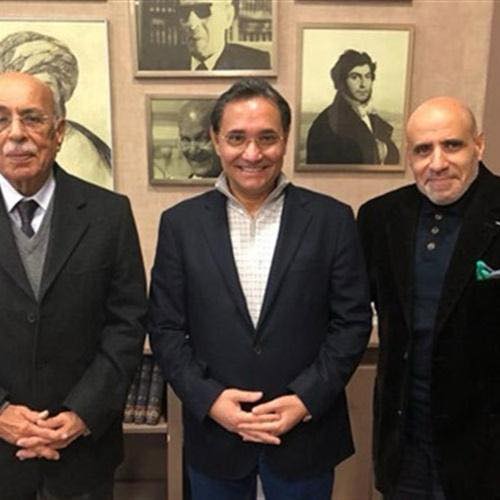
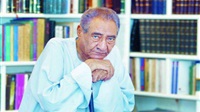
El Sayed Yassin and the Events of Yemen
On April 7, 2016, the Saudi Royal Court announced King Salman’s first visit to Egypt. That visit was the new king’s first foreign trip following the death of King Abdullah.
I received a gracious invitation
from the Saudi ambassador at the time, Mr. Ahmed Qattan, to attend a dinner
hosted by the King and his foreign minister, Mr. Adel al-Jubeir, along with a
number of senior Saudi officials.
After dinner, the Saudi
ambassador and the foreign minister selected a number of thinkers and writers
for a dialogue on several issues related to the two countries and the region.
The ambassador honored me by choosing me among that small group, which could be
counted on the fingers of two hands. We were seven people: the great writer and
thinker El Sayed Yassin ; the prominent intellectual Dr. Mostafa El-Feki; the
distinguished writer Makram Mohamed Ahmed; the writer and political researcher
Dr. Abdel Moneim Said; the Nasserist writer Mr. Ahmed El-Gamal; the journalist
Amr Abdel-Samee’; and myself.
From the very first moment, I
sensed that the Saudi foreign minister wanted to listen more than he wished to
speak, although he ultimately engaged with us and expanded on his remarks. What
all of us said was intriguing enough to prompt him to respond, explain,
interpret, and put many dots on the letters.
Most of the discussions revolved
around the Tiran and Sanafir issue, the stance toward the Syrian regime,
Egyptian-Saudi relations, and a number of important matters. What concerns me
here is how the Saudi minister concluded his remarks, stressing:
“Political action has no place
for emotions. We act in the international community according to our interests
and in line with the requirements of Saudi national security.”
That sentence became the محور of my conversation with the great thinker El
Sayed Yassin when we returned to the office that charged day. He affirmed to me
that the alliance you now see in Yemen between Saudi Arabia and the United Arab
Emirates would end in a catastrophe that could ignite an actual war—not a proxy
one—between the two countries. I told him that I had important information
about Egypt’s refusal to join that alliance when it was asked to do so, for
several reasons, foremost among them that Yemen would be to the alliance what
Vietnam had been to the Americans in the 1960s.
The discussion expanded to
include positions on Iran and the United States, as well as Egyptian-Saudi
relations. He emphasized that Saudi Arabia, in the new era, would seek
rapprochement with Iran according to the parameters of its own national
security in order to completely neutralize it from that map—the map of Saudi
national security—and that it would throw itself into America’s arms in an
unprecedented way to arrange a number of internal matters before external ones.
When the conversation turned to
Egypt and the determinants of its national security, our dialogue branched out
to Egypt’s southern, northern, western, and eastern borders. He stressed that
there were those planning to ignite those borders in the near future to achieve
what they had failed to achieve after January 2011. El Sayed Yassin was among
the thinkers most aware of the role of external schemes aimed at toppling this
country. Perhaps time will allow us to recount what he told me, supported by
documents, in the near future.
El Sayed Yassin also underscored
the danger of the Grand Ethiopian Renaissance Dam file to Egypt’s share of Nile
waters, and the risks of the Declaration of Principles agreement that Egypt
signed with Ethiopia in 2015. I mentioned to him at the time what I had
personally heard from Dr. Mofeed Shehab in Paris regarding the story of the
2015 agreement and the committee President el-Sisi had formed to discuss it and
give an opinion before traveling to Ethiopia to sign it. I also relayed what
Dr. Shehab had personally told me—that he was the one who proposed the
necessity of signing the agreement so that Egypt could later object legally and
internationally to any unilateral action concerning Nile waters during and
after the construction of the dam. Yet El Sayed Yassin said to me quite simply:
if I had been in his place, I would not have done that, nor would I have
advised the president to do so.
I recall all those discussions
now as I watch what is happening on all four of Egypt’s borders—challenges so
heavy that mountains would stagger under them—borne by men who have been true
to what they pledged to God; among them are those who have fulfilled their term
and those who are still waiting, and they have not altered in the least. A calm
policy led us, in the most critical moments of Egypt’s history, to refuse a
Saudi-Emirati request to participate in the Yemen war, and saved Egypt from a
trap that could have led to the destruction of our army—God forbid.
We told them at the time that
Yemen was a ticking bomb, that it would be for them what Vietnam was for
America: a labyrinth in which they would drown. But they never listened to our
advice, and we did not participate.
What is happening now between the
two brotherly countries on Yemeni soil could, if not contained, lead to an open
confrontation between the two—Saudi Arabia and the United Arab Emirates—not
only in Yemen, but in many other arenas, some geographic, some political, some
economic, and the least and rarest of them military.
I return to El Sayed Yassin, that
inspiring intellectual stature in Egypt’s intellectual, scientific, and
political history. I had no personal relationship with him of any kind before
March 2005, save that of a reader to a thinker. I had read most of his great
works and regularly followed his articles in Al-Ahram, Al-Hayat al-Londoniya,
and the newspaper Al-Qahira, whose editor-in-chief at the time was the great
journalist and historian Salah Issa.
One day, however, I was surprised
by a phone call from a friend telling me that El Sayed Yassin had praised my
research efforts in his column in Al-Qahira. He did not stop at praise; he
penned a strange yet beautiful description of my research, explaining that it
was “an effort that only those of firm resolve can undertake.”
My astonishment stemmed not only
from the words of El Sayed Yassin —the greatest research and intellectual
figure at that time (2005), not only in Egypt but in the entire Arab world, and
one of the few Arab researchers whose scholarly efforts were recognized in the
West, especially in France, where he supervised many master’s and doctoral
theses at the Sorbonne, the world’s oldest university. The surprise came when I
recalled the manner of my meeting with him in his office at Al-Ahram a month or
more before the publication of that article. It deeply saddened and hurt me that
I was treated in a way unbefitting a guest who had come to a great thinker to
present him with some of his books. El Sayed Yassin gave me no more than two
minutes, took the books from me, tossed them aside amid piles of volumes,
research papers, bulletins, and scholarly and intellectual journals, thanked me
in a manner that suggested he was occupied with writing and had no time to sit and
listen to anyone, and I left filled with anger.
About a month later, I read that
article, and I was stunned by what he wrote about me and my research. The
article published in Al-Qahira on March 8, 2005 stated verbatim:
“Today at Al-Ahram I was visited
by a researcher of a unique caliber, Mr. Abdel Rahim Ali. This tireless
researcher has worked silently for many long years collecting and analyzing
original documents of Islamic groups, producing them in multiple volumes that
in effect constitute a unique encyclopedia on the subject. Before me are six
volumes of this encyclopedia:
The first volume is The
Encyclopedia of Islamic Movements: Al-Qaeda Organization from Abdullah Azzam to
Ayman al-Zawahiri (1979–2003).
The second volume is a
continuation of the first, as is the third. The fourth volume is devoted to
military documents, with the documentation concluding in that volume, before
moving in the fifth to an important book entitled The Bitter Harvest: The State
and Groups of Religious Violence in Egypt (1971–2004).
The sixth volume is devoted to
the subject of the Muslim Brotherhood: the crisis of the renewal current.
This pioneering scholarly effort
constitutes the most important documentation and writing on Al-Qaeda and other
extremist Islamic groups in the Arabic language.
In our estimation, religious
reform should begin with a critical analysis of this dangerous encyclopedia.
This is an effort that only those of firm resolve can undertake.”
After that article, my
relationship with El Sayed Yassin —the thinker and the human being—deepened. He
became my first reader and my first critic as well. I recall once addressing
him as “Dr. Sayed Yassin,” whereupon he growled, saying: I am not a doctor,
Abdel Rahim; I did not earn a doctorate. He added that a doctorate does not
make your name; international recognition within the research and scientific
community is what makes your name. I do not need this title. I am Sayed Yassin,
and that is enough.
When I thought of launching the
Democratic Forum initiative to confront the Muslim Brotherhood, he was my first
refuge. He helped me write the project idea and discussed it with me and with
those invited to join it, including engineer Naguib Sawiris. He was deeply
saddened when it did not see the light of day.
Instead, when in 2013 I thought
of establishing the Arab Center for Research, El Sayed Yassin had retired from
Al-Ahram at the height of his research and scholarly activity. This decision
was, in truth, regrettable—especially in the world of thought and writing—that
great creators and researchers are sent into retirement at a time when they
still possess energy and scientific expertise capable of producing, and even of
providing guidance and mentorship to younger researchers.
I immediately asked
him—particularly as he felt profound bitterness at having to leave his office
at Al-Ahram, first as head of the Research Center and then as a consultant to
the center, only to sit at home. Truthfully, this was for me like finding a treasure.
I knew the man well, understood his capabilities and the extent of his
scholarly and professional commitment. I found no one better than him as an
intellectual and research mantle under which we could all shelter—students and
disciples alike. He became the center’s first director.
From that time on, fate delighted
me by allowing us to work together. On the first day, I was astonished by what
the man did, leaving me standing in awe of his professional discipline. He came
up to my office on the fourth floor—while his own office was on the second
floor—and said: “Good morning. I’m downstairs in my office if you need me.” I
was truly shocked by the way he addressed me, as I consider him one of my great
teachers. But after my astonishment subsided, he explained that he was an old
employee in the machinery of the Egyptian government, knew the administrative
hierarchy well, and respected it. He was the center’s director, but I was the
chairman of the board.
That incident led me to make it a
daily habit, before going up to my office, to stop by his office so that we
could share a cup of coffee together before I went upstairs.
When I thought of establishing
the Middle East Studies Center in Paris, El Sayed Yassin was my greatest
support. He provided me with the names of several of his students who worked
with me from 2017 to 2020.
My relationship with him deepened
over the five years he worked with me at the Arab Center for Research and
Studies. I saw him as a meticulous researcher, committed to the utmost degree.
When we celebrated his eightieth birthday in my office at Al-Bawaba, I saw joy
light up his face like a child’s. He spoke from the heart and laughed until he
coughed, as usual. His weak lungs constricted with laughter just as they
constricted with the smoke he continued to inhale through the pipe that never
left his bag—until doctors put him on artificial respiration a week before his
death.
On my last visit, I bade him
farewell and said: I will not visit you again, for you have been absent from
your desk for a long time, unlike your habit. He gestured with his hands to
indicate that it would be only days before he would be back at his desk. He
asked for paper and pen, motioned for those in the room to leave, and wrote me
a single word—a word I believe I have remained faithful to ever since, and I
hope to remain so until I meet him again.
Paris: five o’clock in the
afternoon, Cairo time.